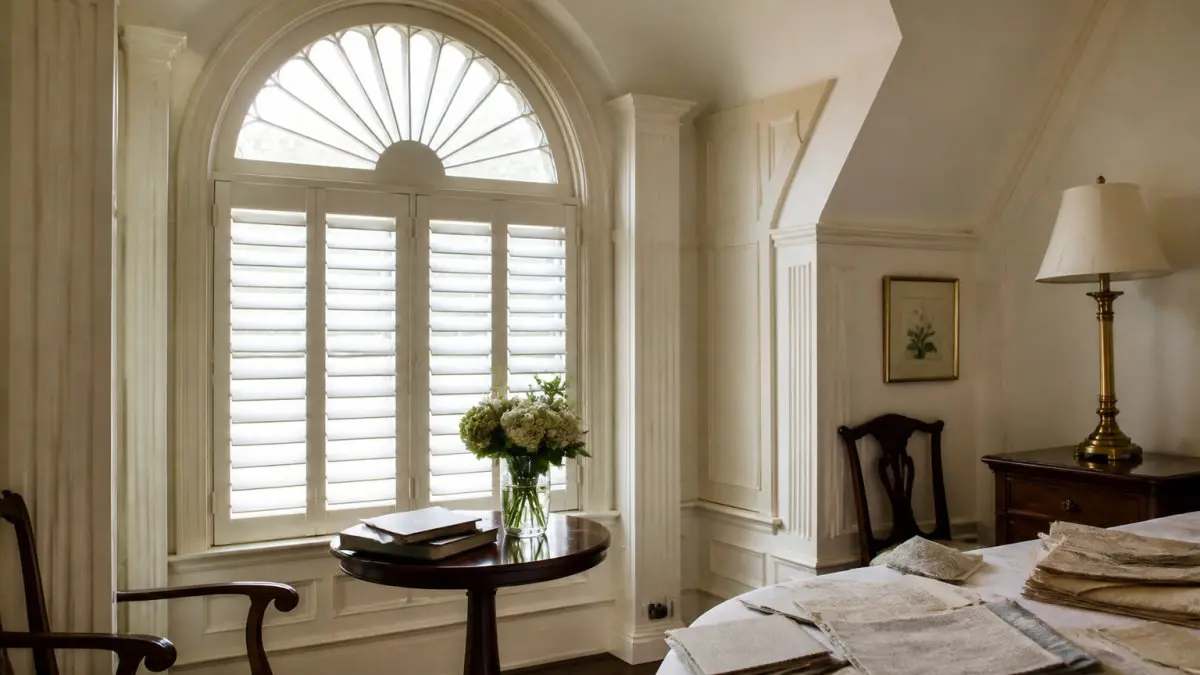
How to Choose a Sunburst Shutters Alternative for Antique Homes
Last Updated: October 30, 2026
Quick Summary
A sunburst shutters alternative for antique homes means matching the covering to the opening instead of forcing a rigid frame into an irregular one. Choose narrow louvers, reversible mounting, and period-appropriate proportions, or use shades and blinds for arched and oversized windows.
- Antique openings often have out-of-level sills and casings patched over many decades.
- Narrow louvers, generally under two inches, read as older and more delicate.
- Photograph the facade and sketch candidate shutter outlines before requesting samples.
- Historic reproduction shutters copy earlier joinery, louver spacing, and panel proportions.
- Measure the opening at top, middle, and bottom, and record the smallest.
Table of Contents
- Why Sunburst-Style Shutters Often Miss on Antique Windows
- Matching Shutter Styles to Your Home’s Era and Architecture
- Historic Reproduction Shutters: What Sets Them Apart
- Plantation Shutter Alternatives That Respect Old Windows
- Window Treatments for Antique Homes: Shades, Blinds, and More
- Comparing Installed Cost and Long-Term Ownership
- Handling Irregular, Original, and Unusually Sized Windows
- Book a Custom Measurement for Your Antique Windows
- Frequently Asked Questions
Why Sunburst-Style Shutters Often Miss on Antique Windows
A sunburst shutters alternative for antique homes starts with an honest look at the window itself. Antique windows rarely cooperate. Antique openings often show out-of-level sills and casings patched over many decades.
That mismatch is the whole problem. A rigid frame forced into an irregular opening leaves gaps at the edges, and gaps mean light leaks, drafts, and a silhouette that looks wrong from the street.
Three issues come up again and again:
- Standard frame depths assume modern wall cavities, not the deep plaster returns of century homes.
- Wide louvers look oversized next to narrow period trim.
- Mounting hardware gets screwed into original casing, which is hard to undo later.
The alternative isn’t one product. It’s a set of approaches matched to the era, the opening, and how much you’re willing to alter.
Matching Shutter Styles to Your Home’s Era and Architecture
Period-appropriate design starts with the house, not the catalog. A shutter that suits a Prairie-style home will look heavy on a Federal-era facade, and vice versa. The gap in most buying guides is that they describe styles in the abstract. What actually helps is a way to read your own facade and narrow the field before you shop.
A Practical Era-by-Era Framework
Use the table below as a starting point, then confirm against any surviving shutters, hardware ghosts, or paint shadows on the siding. Those physical clues outrank any general guide, including this one.
| Era (approximate) | Typical shutter form | Louver proportion | Hardware conventions |
|---|---|---|---|
| Colonial and Federal | Paneled or louvered, full height, often fixed | Narrow louvers, fine rails | Strap hinges, small holdbacks, no center tilt |
| Greek Revival and Italianate | Tall louvered pairs, sometimes with a fixed panel | Narrow to medium louvers | Heavy strap hinges, shutter dogs |
| Victorian and Queen Anne | Mixed: louvered, paneled, and combination | Varies; decorative cutouts common | Ornamental hinges, cast holdbacks |
| Craftsman and Prairie | Simpler rails, stronger horizontal lines | Medium louvers | Straight hinges, simple dogs |
| Colonial Revival | Revival of earlier forms, often paired | Narrow louvers | Reproduction strap hardware |
Treat the ranges as guidance, not code. Regional millwork varied widely, and a house built in one era was often updated in another. The point is to give yourself three or four plausible candidates instead of the whole catalog.
Reading the Clues: Trim, Louvers, and Proportion
Look at four things before you shop.
Trim profile. Wide flat casings with simple backbands point toward certain eras; narrow molded profiles with more complex sections point toward others.
Surviving louver width. If any original shutter survives, measure the louver. Matching that proportion keeps the facade coherent even when the new unit is a reproduction.
Hardware ghosts. Filled screw holes, paint shadows, and rust stains on the siding mark where hinges and holdbacks once sat.
Glass-to-wall ratio. Tall, narrow openings with generous wall between them read differently from wide openings set close together. The shutter’s rail placement should echo that rhythm.
Narrow louvers, generally under two inches, read as older and more delicate. Wide louvers read as mid-century or later. If the house predates that shift, narrow is usually the safer call.
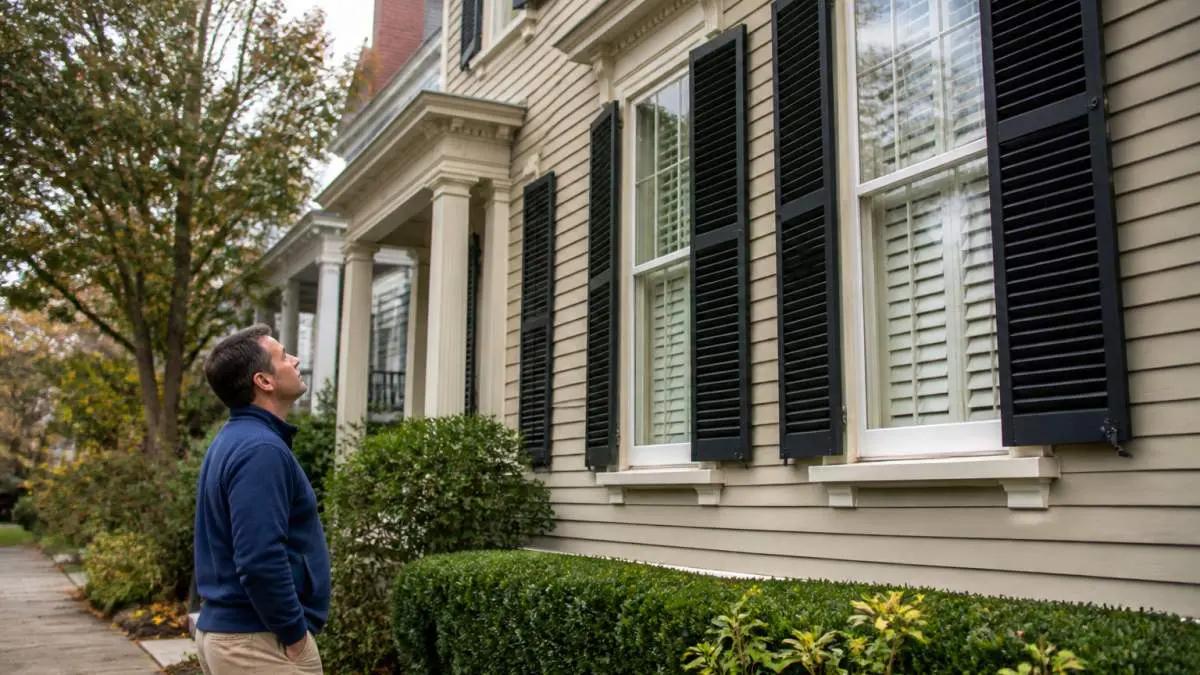
Photograph the facade straight-on from the sidewalk and again from an angle. Print both. Sketch candidate shutter outlines on the prints before you request samples. Proportion problems that are invisible on a swatch become obvious on a full elevation.
Historic accuracy is less about exact replication and more about proportion. A reproduction shutter that gets the louver width and rail placement right will look correct even if the wood species differs. That is also why reversibility matters: a proportionally correct shutter mounted so it can be removed later preserves the option to correct a mistake without damaging original fabric.
Matching Treatments to Architectural Styles
The same logic applies to interior coverings. In a room with deep plaster returns and narrow casing, a full-height interior shutter with a wide frame can crowd the opening. A café-style half panel or an inside-mount shade often reads better because it leaves the casing visible. In a later home with simpler trim, a full-height interior shutter is less likely to compete with the architecture.
When in doubt, choose the treatment that disappears into the opening rather than the one that announces itself. Antique facades and interiors reward restraint.
Historic Reproduction Shutters: What Sets Them Apart
Historic reproduction shutters are built to copy the joinery, louver spacing, and panel proportions of an earlier period rather than a modern standard.
The trade-off is lead time. For owners of distinctive homes who plan to stay, that wait usually pays off in how the facade reads.
Plantation Shutter Alternatives That Respect Old Windows
Plantation shutter alternatives fall into a few practical camps, and the right pick depends on how much you want to attach to original wood.
For exterior shutters, many antique homes never had functional exterior shutters, and adding them changes the facade.
Watch out: screwing reproduction exterior shutters through original siding without a plan for patching means the next owner inherits holes they can’t undo.
Window Treatments for Antique Homes: Shades, Blinds, and More
Window treatments for antique homes don’t have to mean shutters at all. For arched, oversized, or irregular openings, soft coverings often fit better and cost less.
Comparing Installed Cost and Long-Term Ownership
Cost comparisons for antique windows are tricky because so little is standard. Custom sizing, irregular openings, and reproduction joinery all push the number up, and no two houses land in the same place. But refusing to discuss cost at all leaves readers worse off than a competitor that at least names the variables. The useful approach is to break the number into its parts so you can estimate your own job.
What Drives the Installed Number
Every quote for an antique opening is built from the same components:
- Measurement and templating. Irregular openings take longer to measure and often require a template. This is labor, and it scales with the number of unique openings.
- Custom fabrication. Reproduction joinery, narrow louvers, and nonstandard sizes move the unit from stock to mill-shop pricing.
- Mounting method. A screw-in installation is fast; a reversible system that protects original casing takes more time and hardware.
- Finish. Factory finish is cheaper per unit; site finishing on older wood takes labor and drying time.
- Removal and patching. If old hardware or failed shutters must come off, add labor for careful removal and for patching holes in original siding or casing.
A Category-by-Category Ownership View
| Option | Fit for Irregular Openings | Reversible | Maintenance | Best For |
|---|---|---|---|---|
| Historic reproduction shutters | Excellent, built to measure | Moderate, depends on mounting | Periodic refinishing | Owners staying long term |
| Plantation-style shutters | Fair, limited by standard frames | Low if screwed in | Wipe-down | Square modern openings |
| Interior tension-fit shutters | Good | High | Low | Rentals and resale prep |
| Shades and blinds | Excellent | High | Low to moderate | Arched and oversized windows |
| Custom curtains | Excellent | High | Cleaning and rehanging | Period interiors |
Long-Term Ownership Costs
Unit price is only the entry fee. The costs that accumulate over a decade fall into four buckets:
Refinishing. Painted wood shutters on an exterior exposure typically need attention on a multi-year cycle, and the cycle shortens on the sunny side of the house. Factory-finished composite units reduce this, but they read as modern up close.
Hardware replacement. Strap hinges, shutter dogs, and holdbacks wear. Hand-forged iron lasts, but it costs more up front and may need periodic lubrication.
Operating wear. Functional shutters that are actually opened and closed wear at the hinges and at the tilt rods. Shutters that are decorative only avoid this but lose the storm-protection benefit.
Replacement cycle. A reproduction unit built from good stock and finished correctly can last decades.
The cheapest unit price rarely wins over a long horizon. A reproduction unit that lasts decades costs less per year than a replacement cycle, even though its sticker is higher.
Do not accept a phone quote for an antique opening. Any number given without a measurement is a guess, and the guess is usually low. Ask for a written scope that names the mounting method, the finish, and what happens to existing hardware holes.
Getting a Real Number
Pricing depends on the specifics of each opening. For a current price or a quote, contact Carroll Shade directly or visit our website.
Handling Irregular, Original, and Unusually Sized Windows
Irregular windows are the norm in century homes, not the exception. Arched transoms, bowed bays, and openings that have settled out of square all need a measuring approach that assumes nothing.
A workable sequence:
- Measure the opening at three points, top, middle, and bottom, and record the smallest.
- Check for out-of-square by measuring both diagonals.
- Note the depth of the reveal and any obstructions like sash weights or cranks.
- Decide whether the covering mounts inside the reveal or on the casing.
- Confirm the hardware won’t interfere with the sash operation.
For arched windows, a shade mounted on a curved track or a custom-shaped frame usually beats forcing a rectangular shutter into the opening. For unusually tall windows, motorized coverings solve the reach problem without a ladder.
Book a Custom Measurement for Your Antique Windows
The gap between a shutter that fits and one that almost fits comes down to measurement. For antique windows, that step deserves a trained eye and a tape measure, not an online calculator.
At Carroll Shade, we’ve served homeowners in the Brookline and Boston area since 1932. We offer expert window installation and repair services, and we’re an authorized Hunter Douglas partner.
If you’d rather talk it through first, our contact page has the details for reaching our team and arranging a visit.
Frequently Asked Questions
What are good alternatives to Sunburst Shutters for antique homes?
The best fit depends on your window’s era and condition. Historic reproduction shutters built to period proportions, interior wood shutters with narrow louvers, and custom shades or blinds that mount without drilling into original trim are all common choices. For irregular or arched openings, a custom-measured solution avoids the gaps that stock sizes leave. Ask for reversible mounting so nothing damages the original woodwork, and confirm the maker can match your window dimensions exactly rather than trimming a standard panel to fit.
What is the difference between historic reproduction shutters and plantation shutters?
Historic reproduction shutters are built to match the proportions, louver widths, and joinery of a specific period, so they look original to the house. Plantation shutters use wider louvers and a heavier frame, which reads as a modern interior treatment. In a 1920s or Victorian home, wide-louver plantation panels can look out of place next to narrow original trim. Reproduction shutters cost more because they are custom-built, but they preserve historic accuracy and often suit a preservation review better than a standard plantation panel.
Are plantation shutters appropriate for historic houses?
They can work, but the fit matters more than the label. Wide louvers and thick frames suit some mid-century and Prairie-style homes and clash with older interiors that used narrow louvers. If you want plantation shutter alternatives for a period home, look for narrower louver widths, a frame profile that matches your existing trim, and a mounting method that does not require new holes in original casing. Reversibility is the test: if the treatment can come down without repair, it is a safer choice for a historic building.
Can modern window treatments work with original antique windows?
Yes, provided they are measured to the actual opening rather than a standard size. Original windows are rarely square, so precise measurement matters. For hard-to-reach windows, motorized options can be considered to operate a high window without a ladder.
The challenge with antique windows is that nothing about them is standard, and stock solutions show it. Carroll Shade can measure your openings, recommend coverings that respect the era, and handle installation and later repairs with the same team. Get started with Carroll Shade and get window treatments that fit the house you actually own.

