
Are Cellular Shades the Best Window Treatments for Heat Loss?
Last Updated: November 1, 2026
Quick Summary
Cellular shades are the strongest interior window treatments for heat loss because their honeycomb cells trap air against the glass, and they perform best when close-mounted with side channels and a bottom seal. Installation decides the outcome more than the product label, since gaps at the sides, top, and bottom restart the convective loop that drains warmth.
- Closed blinds and shutters cut heat loss through windows by up to 33%, per British Blind and Shutter Association tests.
- Awnings can cut solar heat gain by up to 65% on south-facing and 77% on west-facing windows.
- Side channels are the single biggest upgrade for winter performance, blocking the lateral air path.
- If the recess leaves more than about a finger’s width of clearance per side, an outside-mount usually outperforms a flush inside-mount.
- Raise south-facing shades on sunny winter days to admit solar heat, then lower them at night.
Table of Contents
- Heat Loss vs. Heat Gain: Why the Distinction Decides Your Treatment
- Cellular Window Shades: The Insulation Leader for Heat Loss
- Thermal Curtains for Windows: What the Evidence Actually Shows
- The Best Blinds for Insulation: Cellular, Roman, and Roller Compared
- Window Insulation for Winter: Installation Details That Make or Break Performance
- Solar Shades, Shutters, and Films: Where They Win and Where They Don’t
- How to Match a Treatment to Your Specific Windows
- Book a Custom Window Assessment with Carroll Shade
- Frequently Asked Questions
Heat Loss vs. Heat Gain: Why the Distinction Decides Your Treatment
Most homeowners treat “energy efficiency” as one problem. It is two, and they run in opposite directions. Heat loss is warm indoor air escaping through glass and gaps during cold months. Heat gain is solar radiation entering and trapping warmth during hot months.
Homeowners who buy for winter insulation and homeowners who buy for summer shade rarely need the same product.
Winter Heat Loss: Stopping Warm Air From Escaping
Winter performance is about resistance to heat transfer. Insulating coverings work by trapping air between the glass and the room, and by sealing the edges where cold air leaks in. A common mistake is buying a heavy fabric and leaving a two-inch gap around the frame; the gap undoes most of the benefit. The treatment must be operable, fitted close to the window, and closed at night.
Summer Heat Gain: Blocking Solar Heat Before It Enters
Summer performance is about reflection and shading, not trapped air. Here exterior treatments have a structural advantage because they stop sunlight before it reaches the glass. According to Consumer Reports’ analysis of window coverings, awnings can cut solar heat gain by up to 65% on south-facing windows and up to 77% on west-facing windows. Medium-colored draperies with white plastic backings reduced heat gain by 33% in the same reporting.
Cellular Window Shades: The Insulation Leader for Heat Loss
Cellular window shades are a strong interior option for winter heat loss because their honeycomb cells trap pockets of air directly against the glass.
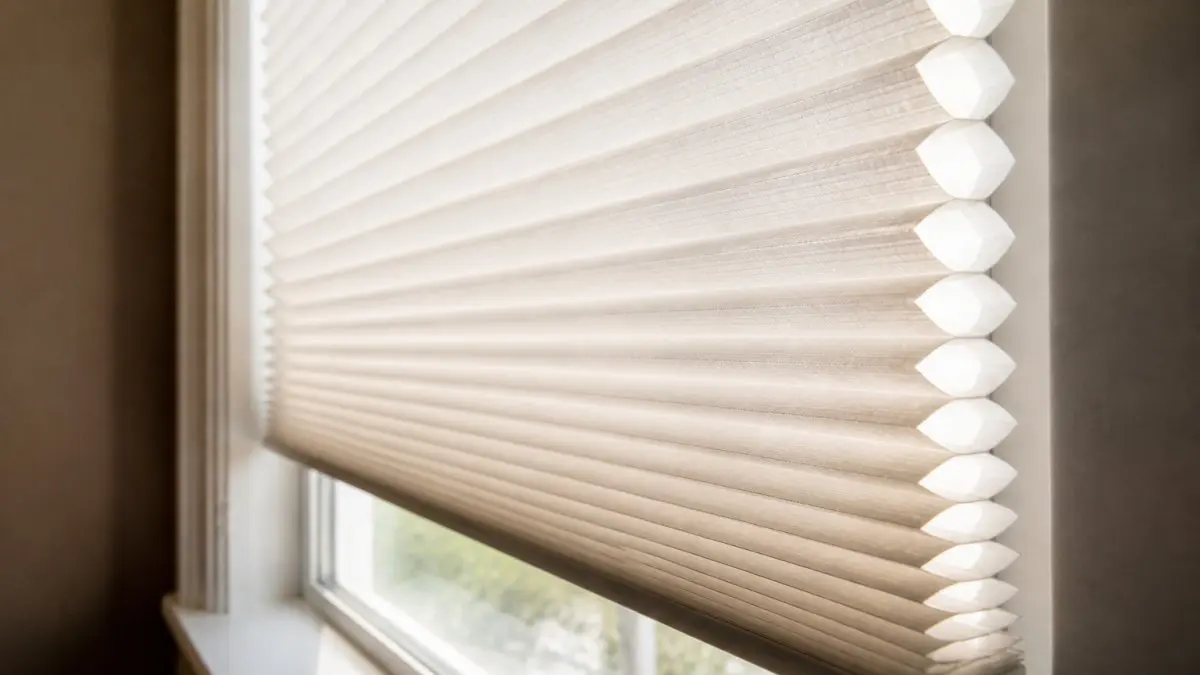
Deeper cells mean more trapped air and better thermal insulation. The trade-off is bulk at the window head and a higher cost than flat shades.
Thermal Curtains for Windows: What the Evidence Actually Shows
Thermal curtains for windows perform well when they are heavy, lined, and mounted to overlap the frame. The Consumer Reports findings on lined draperies show a 33% heat-gain reduction for medium-colored draperies with white plastic backings, citing U.S.
Curtains also cover more wall area than shades, which helps, but they hang away from the glass and leak at the top unless you use a ceiling-mounted track.
The Best Blinds for Insulation: Cellular, Roman, and Roller Compared
Cellular shades are a strong option for winter insulation, and Roman shades can also help depending on fabric and fit.
| Treatment | Winter Heat Loss | Summer Heat Gain | Best For |
|---|---|---|---|
| Cellular shades | Strongest interior option | Good | Cold rooms, bedrooms |
| Roman shades | Moderate, fabric-dependent | Moderate | Style-led rooms |
| Roller shades | Weak | Good | Simple heat-gain control |
| Shutters | Moderate with tight fit | Moderate | Hard-wearing, low-maintenance rooms |
| Solar shades | Weak | Strong | Glare and UV control |
| Reflective film | Minimal | Moderate | Fixed glazing, rentals |
Roman shades insulate only as well as their fabric and lining allow.
Window Insulation for Winter: Installation Details That Make or Break Performance
Installation decides the outcome more than the product label does. A premium cellular shade mounted loosely performs like a cheap roller shade; a mid-grade shade sealed at the edges can outperform it.
Tests reported by the British Blind and Shutter Association, based on University of Salford work, found that closed blinds and shutters cut heat loss through windows by up to 33%.
Inside-Mount vs. Outside-Mount: The Trade-Off Nobody Explains
An inside-mount (recess) shade looks cleaner and preserves the window trim, but it only insulates well when the recess is deep enough for the fabric to sit close to the glass and the side gaps are small. An outside-mount shade overlaps the wall and frame, which covers more area and can seal better, but it projects into the room and can interfere with furniture, curtains, or a radiator.
The Three Seals That Matter
- Side channels or side tracks. These are the single biggest upgrade for winter performance. A channel captures the shade edge and blocks the lateral air path. Without them, air slips around the fabric no matter how heavy it is.
- Bottom seal or sill contact. A weighted hem that rests on the sill, or a magnetic or brush bottom bar, closes the gap where cold air pools. A shade hovering two inches above the sill is an open door for convection.
- Headrail tight to the frame. The top gap is easy to ignore because it is above eye level. A headrail fixed tight to the frame, with no visible light leak, closes it.
Do the light test at night. Close the treatment, turn on the room lights, and look from outside (or have someone check from the room while you shine a flashlight along the edges). Any visible light line is an air path. Weatherstripping, a side channel, or a bottom bar is the fix.
Custom Fabrication for Awkward Openings
Arched, angled, and antique windows are where stock sizes fail. A rectangular shade over an arched opening leaves crescent gaps at the top corners that defeat the air pocket. Custom fabrication is the only way to close those gaps, and it is also the reason two windows of the same size can need different treatments. You can review expert window installation and repair services to see how professional fitting handles the details that decide performance.
What Installation Cannot Fix
Be clear about the limit. Treatments manage the window you have; they do not replace it. If the frame itself leaks, the sash does not latch, or the glazing is single-pane with a failed seal, no covering will close the gap. ENERGY STAR guidance on residential windows frames performance around U-factor and solar heat gain coefficient for a reason: the window assembly sets the baseline, and the treatment adjusts it.
Solar Shades, Shutters, and Films: Where They Win and Where They Don’t
That makes them excellent for west-facing rooms in summer and poor choices for a drafty window in January.
How to Match a Treatment to Your Specific Windows
Most guides hand you one universal winner. Match by glazing, orientation, frame condition, and how the room is used, then operate the treatment correctly, because an insulating shade left open all winter insulates nothing. ENERGY STAR guidance on residential windows frames window performance around U-factor and solar heat gain coefficient, which is the honest starting point: treatments manage the window you have, they do not replace it.
Match by Glazing and Frame Condition
- Single-pane windows: the highest heat-loss case. Prioritize a close-mounted cellular shade with side channels and a bottom seal, or a heavy lined drapery on a ceiling track. The treatment is doing most of the work here.
- Double-pane windows: a well-fitted cellular shade or insulated drapery still helps, but the marginal gain is smaller. Spend on fit and sealing before spending on fabric thickness.
- Triple-pane or high-performance glazing: the window is already doing the heavy lifting. Focus on air leakage at the frame and on summer heat gain rather than on adding R-value.
Match by Orientation and Season
- North-facing, drafty: cellular shades, close-mounted, closed at night. Little winter solar gain to lose, so prioritize insulation.
- South-facing: cellular shades in winter; raise them on sunny days to admit solar heat, as Cornell Cooperative Extension advises, then lower at night to hold the warmth in.
- East-facing: morning sun is gentler; cellular shades or lined drapery work well, with solar shades if glare is the bigger issue.
Operate for the Season, Not Just the Purchase
Winter operation: open south- and east-facing treatments during sunny daytime hours to admit free solar heat, then close them at dusk to trap it. Keep north-facing treatments closed during cold snaps. Summer operation: close west- and south-facing treatments during peak afternoon sun, and open them at night when outdoor air is cooler than indoor air.
Weigh Cost, Payback, and the Trade-Offs You Will Live With
Payback depends on your climate, window count, and how often you actually operate the treatment, so treat any single payback figure with suspicion. Compare on the trade-offs too: cellular shades insulate well but reduce daylight and can be harder to clean; shutters are durable and easy to wipe but costly; solar shades preserve views but do little for winter loss; films are permanent and suit renters poorly.
Quick Reference
- North-facing, drafty: cellular shades, close-mounted.
- South-facing: cellular shades in winter; raise them on sunny days to admit solar heat, then lower at night.
- West-facing: solar shades or exterior awnings for afternoon heat.
That last point matters more than any specification. An insulating shade left open all winter insulates nothing.
Book a Custom Window Assessment with Carroll Shade
Specifications only tell you so much; your windows decide the rest. We measure on site, account for orientation and frame depth, and recommend treatments that fit the opening rather than the catalog. As an authorized Hunter Douglas partner, we offer custom window treatment solutions, including motorized options, plus repair service for treatments that have stopped working.
Pricing depends on window count, size, and fabric, so we quote after measuring rather than guessing. Contact us to arrange an assessment.
Frequently Asked Questions
Do cellular shades help keep heat in during winter?
Yes. Cellular shades, also called honeycomb shades, trap air inside their cell structure, which creates an insulating layer between the room and the cold glass. Cellular shades can help reduce heat loss in winter. The benefit depends on a tight fit; shades mounted close to the glass and side channels that seal the edges perform better than loose-hanging versions. For older homes with uneven window frames, custom measuring matters more than the fabric choice.
Are curtains or blinds better for insulating windows?
It depends on the season and the construction. Thermal curtains for windows, especially lined draperies can help reduce heat gain. Cellular shades generally insulate better against winter heat loss because the air pockets sit directly against the glass. Blinds alone leave gaps at the edges where air moves freely. A layered approach, with a cellular shade plus side drapes, covers both heat loss and heat gain.
What type of blinds are best for blocking out heat?
Cellular shades with a tight perimeter fit are a strong choice for insulation, and Roman shades with a lined backing can also help. Roller and solar shades can help filter sunlight in warmer months. If summer heat is the main problem, exterior treatments can be an option to consider.
Should window treatments stay open during sunny winter days?
Yes, on sunny winter days. Raising shades on sun-facing windows during the day can let solar heat in, and lowering them at night can help reduce heat loss. The reverse applies in warmer months: close treatments during the day to block solar heat and open them at night. Running shades closed all day in winter blocks free solar gain and can make rooms feel colder than necessary.
How should window treatments fit to reduce drafts and heat loss?
Fit matters as much as fabric. Mount shades as close to the glass as possible, ideally inside the window frame with side channels, so air cannot bypass the treatment. For winter heat loss, an inside mount with sealed edges reduces drafts. Gaps of a quarter inch or more around a shade undermine the insulation value of even the best cellular fabric. Custom measurement is the difference between a treatment that insulates and one that just decorates.
Can window coverings lower heating costs?
They can reduce the heat escaping through windows, which is one part of your heating bill. How much that translates to your bill depends on window count, glazing quality, and climate. Window performance also depends on factors such as U-factor and solar heat gain coefficient, so treatments work best alongside efficient windows rather than as a replacement for them.
Your heating bills and your summer cooling costs are both decided at the glass, and the right treatment depends on details a product page cannot see. Carroll Shade brings custom design, professional installation, motorized options, and ongoing repair service to every project, backed by a family-owned business that has served this community since 1932. Get started with Carroll Shade and fit your windows properly the first time.

