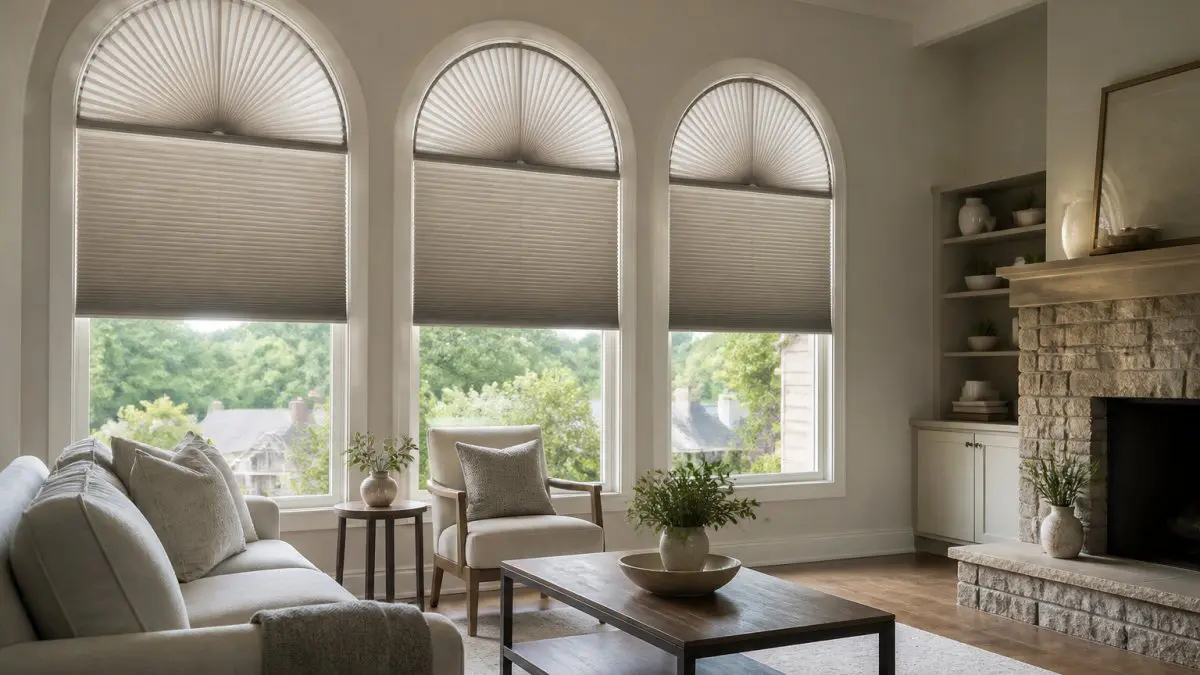
Custom Window Shades for Arched Windows: 2026 Guide
Table of Contents
- Why Custom Window Shades for Arched Windows Beat Stock Options
- Measuring Complex Arches Without Costly Mistakes
- Custom Arched Window Blinds: Materials and Mounting Hardware
- Blinds for Arched Windows: Fixed, Operable, and Cordless
- Shades for Half-Moon Windows: Handling Curves and Tension
- Light-Filtering Arch Window Shades for Privacy and Glare
- Motorization, Smart Home Control, and Energy Efficiency
- Troubleshooting Arch Shade Installation and Repairs
- Frequently Asked Questions
Last Updated: October 7, 2026
Why Custom Window Shades for Arched Windows Beat Stock Options
Stock shades are built for rectangles, so arched windows end up with gaps, light leaks, and fabric bunching at the curve. Custom window shades for arched windows are cut to your window’s actual silhouette, so the shade follows the arc instead of fighting it. At Carroll Shade, we have fitted these treatments in the Boston and Brookline area since 1932, and the pattern is consistent: the windows that look best are measured and manufactured for that specific opening.
How Arch Geometry Changes the Shade You Need
An arched window is a rectangle topped by a curve, and the curve varies by style: half-round, segmental, eyebrow, or Gothic point. Each changes how a shade is tensioned and trimmed.
Two windows in the same room can look identical and still need different patterns, because the spring line (where the curve meets the vertical sides) sits at a different height.
What Custom Fit Actually Delivers
Custom-fit shades solve four problems stock options create:
- No light gaps at the curve, where rectangular shades leave a crescent of glare
- Correct tension across the arc, so fabric does not pucker or pull
- Matching opacity for every window in the room, even when sizes differ
The single biggest reason arched shades fail is not the fabric. It is the pattern. A shade cut for a generic arch will not fit a window with a different rise, no matter how carefully it is installed.
Measuring Complex Arches Without Costly Mistakes
An arch has three dimensions that matter, not two. Get any one wrong and the shade will not seat. Here is our protocol.
The Three Numbers That Define the Pattern
Every arched shade pattern is built from three measurements:
- Base width, the flat span at the spring line, where the curve meets the vertical sides. Measure there, not at the floor or the widest point.
- Rise, the vertical distance from the spring line to the arc’s peak. On a half-round, rise equals half the base width; on a segmental or eyebrow arch, the rise is shorter and the radius larger.
- Depth, the distance from the front of the window recess to the glass, which determines whether an inside mount clears the sash and how much room the headrail has.
Write all three down in inches.
Step-by-Step: Measuring a Perfect Arch
- Find the spring line. Run a level across the window where the vertical sides stop and the curve begins. Mark both sides with painter’s tape.
- Measure the base width between the tape marks, at the glass, not the trim.
- Measure the rise from the spring line straight up to the arc’s peak. Hold the tape plumb; a tilted tape reads long.
- Measure the depth at left, center, and right, and record the smallest number, that is what the headrail has to clear.
- Photograph the window with the tape at the spring line, the most useful thing you can send a fabricator.
Measuring an Imperfect or Asymmetric Arch
Real arches are rarely perfect. Settling, construction tolerance, and trim replacement push the curve off-center. If the left half rises higher than the right, a single-radius pattern will not fit.
- Measure the rise on both sides of the peak, not just the center.
- Measure the base width at the spring line and at the widest point of the curve. On a segmental arch, the widest point is often above the spring line, so a base-only measurement understates the window by an inch or more.
- Check corner-to-corner diagonals at the spring line. If they differ by more than a quarter inch, flag it for the fabricator.
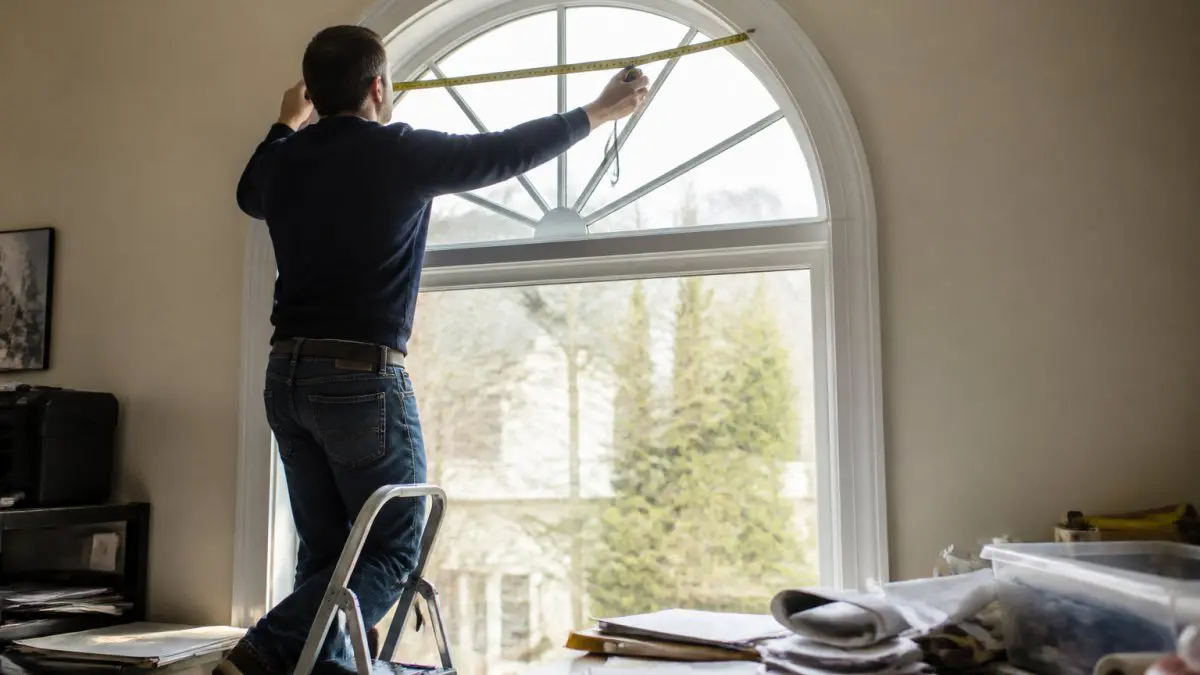
Tools and Safety for High or Hard-to-Reach Windows
You need a metal tape measure (cloth stretches and reads long), a 24-inch level, painter’s tape, a pencil, and a ladder rated for the height.
For second-story or stairwell windows, do not lean out over a sill. Measure from inside where possible, and bring in a professional for anything you cannot reach with both feet planted.
Inside Mount vs. Outside Mount for Arches
Inside mount tucks the shade into the recess for a clean, architectural look. Outside mount sits on the wall or frame, hiding imperfect trim and giving more room for the curve.
| Mount Type | Best For | Trade-off |
|---|---|---|
| Inside mount | Deep, square recesses; clean sightlines | Needs accurate depth; less forgiving of uneven frames |
| Outside mount | Shallow recesses; covering old trim | Slightly bulkier profile; overlaps the wall |
If you take only one thing from this section: measure the rise at the spring line, measure it on both sides, and write it down to the nearest eighth of an inch. The rise is the number that defines the radius, and the radius is the number that defines whether the shade fits.
Custom Arched Window Blinds: Materials and Mounting Hardware
Custom arched window blinds and shades live or die on two things: the material’s ability to hold a curve, and hardware that keeps the shade square. Cellular shades hold an arc well. Pleated blinds are lighter. Woven wood brings texture and warmth.
Cellular, Pleated, and Woven Options Compared
- Cellular: best insulation, cleanest curve, widest range of opacity
- Pleated: lightest look, lowest cost, best for low-traffic windows
- Woven wood: strongest texture and movement, best for period homes
Mounting hardware matters more on an arch than a rectangle. Brackets must anchor into solid framing, not just drywall. At least a quarter inch of frame clearance keeps fabric from rubbing.
Blinds for Arched Windows: Fixed, Operable, and Cordless
Blinds for arched windows come in three operating types, depending on how you use the window.
- Fixed: the shade stays in place, softening daylight without adjustment. Best for decorative arches you never open.
- Operable: the shade raises and lowers with a cord, wand, or motor. Best for windows you actually use for ventilation or view.
- Cordless: push up, pull down, no dangling cord. The safest choice in homes with children or pets, and the cleanest look.
For a half-round that never opens, a fixed shade is the honest answer. Do not pay for operability you will not use.
Shades for Half-Moon Windows: Handling Curves and Tension
Shades for half-moon windows need even tension across a single continuous arc. If one side of the headrail is tighter, the fabric drifts and the curve looks lopsided. The fix is a headrail built to your window’s exact radius, plus brackets set level to each other.
Light-Filtering Arch Window Shades for Privacy and Glare
Light-filtering arch window shades soften daylight without blacking it out, which is usually what an arched window wants. These windows often sit high or over a doorway, where full blackout looks heavy. Light filtering cuts glare, protects furnishings from UV, and keeps the room open.
Opacity runs on a spectrum: sheers soften daylight and give daytime privacy but little at night, while room-darkening fabrics block most light.
Motorization, Smart Home Control, and Energy Efficiency
Motorized shades are the practical answer for hard-to-reach arches. A second-story or stairwell window you would never adjust by hand becomes usable with a remote or app. Modern motors are quiet and integrate with common smart home systems so the shade can follow a schedule or the sun.
How Motorization Actually Works on an Arch
Three practical points:
- Power source. Battery motors avoid running line voltage to a high window, often the deciding factor on a stairwell arch. Hardwired motors are smoother and never need charging.
- Control options. Remote, wall switch, app, or voice. Most systems support all four; pick the one you will actually use.
- Scheduling. The real value is the schedule, not the voice command. A shade that closes itself at 3 p.m. in July does more for glare and heat gain than one you remember to close.
A Realistic Look at Energy Efficiency
On energy efficiency, shades help, but they are one layer of a whole-window strategy. Cellular shades with a sealed honeycomb trap air at the glass, reducing heat loss in winter and heat gain in summer. Pair them with proper sealing and, where appropriate, exterior protection.
Seasonal Operating Strategy
How you run the shade matters as much as what you buy:
- Winter, daytime: open shades on south-facing arches to let solar gain in. Close them at dusk to hold the heat that came through.
- Winter, nighttime: closed shades reduce heat loss at the glass. This is where cellular construction earns its cost.
- Summer, daytime: close shades on east and west arches during peak sun. West-facing arches in the afternoon are the biggest heat-gain offenders in most homes.
A top-down bottom-up shade is a flexible option on an arch, because it lets you block the high sun at the top of the curve while keeping the lower glass open for light and view.
Do not treat a shade as a substitute for air sealing.
Where Smart Control and Efficiency Meet
Motorization and energy efficiency belong together because of scheduling. A manual shade only insulates when someone remembers to close it; a motorized shade on a schedule insulates every day, whether you are home or not. For a hard-to-reach arch, that difference is the whole point.
Troubleshooting Arch Shade Installation and Repairs
Most arch shade problems trace back to three causes: an out-of-level headrail, a pattern that does not match the window radius, or brackets that pulled loose from inadequate anchoring.
- Shade drifts to one side: re-level the headrail and check bracket tightness
- Fabric puckers at the curve: the radius is wrong; the shade needs remeasuring
- Shade will not stay up: the tension spring is worn or the cord is frayed
Repairs are usually faster and cheaper than replacement. Cords, tension springs, and brackets are serviceable.
Arched windows are the hardest openings in the house to dress well, and the difference between a shade that looks custom and one that looks improvised comes down to measurement and pattern. Carroll Shade has handled that work for homeowners in the Boston and Brookline area since 1932, as an authorized Hunter Douglas partner offering custom design, professional installation, motorized options for hard-to-reach windows, and repair service when something needs attention.
Frequently Asked Questions
What kind of shades are best for an arched window?
Cellular and pleated shades designed for arches are the most common choice because they hold their shape along a curve and come in light-filtering or room-darkening versions. For half-moon windows, a custom-fit cellular shade with a tension system prevents sagging. If the arch sits above a rectangular window, pair a fixed arch shade with an operable shade below so you keep daily light control.
Can custom arched window blinds be made to fit an odd-shaped arch?
Yes. Custom arched window blinds are built from the exact template of your opening, so a 1920s eyebrow arch or a segmented arch gets the same precise fit as a standard half-round. That is why custom blinds close the light gaps stock sizes leave behind.
How do you measure an arched window for custom shades?
Measure the width at the widest point of the arch, the height at the center, and the height at both edges. Note the window depth and any frame clearance for mounting hardware. For inside mount, measure the recess; for outside mount, add overlap on all sides.
How much do custom window shades for arched windows cost?
Pricing depends on the size of the arch, the fabric you choose, whether the shade is fixed or operable, and whether you add motorization. A small fixed half-moon shade costs less than a large operable cellular shade with a remote. For current pricing and a quote tailored to your windows, contact Carroll Shade directly.
Should arched window shades be fixed in place or operable?
Fixed shades work well for transom arches that sit above another window and mainly need daylight softening. Operable shades make sense when the arch is the only window in the room or when you want privacy control at night. Many homeowners choose a fixed arch shade plus an operable shade below, which keeps the architectural feature visible while still letting you adjust light.
Do light-filtering arch window shades help with energy efficiency?
Light-filtering arch window shades soften daylight and reduce glare, and cellular versions add a layer of thermal insulation at the glass. The air pockets in cellular fabric slow heat transfer, which can ease the load on your heating and cooling system. The exact savings depend on your window size, exposure, and home insulation, so treat energy claims as one benefit among several rather than a guaranteed dollar figure.
Can motorized shades be installed on hard-to-reach arched windows?
Yes. Motorized options let you raise, lower, or tilt a shade from a remote or a smartphone app, which is useful for second-story arches and tall foyers. Battery-powered motors avoid running new wiring, and some systems integrate with smart home platforms for scheduled daylight softening. Ask about motor reliability and warranty terms before you buy.
What if something goes wrong after installation?
Reputable providers offer repair service for damaged or malfunctioning shades, including cord replacement, motor service, and hardware fixes. Before you buy, ask what the warranty covers and how service calls are handled. A local provider that stocks parts and knows your window type can usually resolve issues faster than a national retailer.
