Energy Efficient Window Shades for Boston Homes: 7 Best Picks
Table of Contents
- Quick Comparison: Best Energy Efficient Window Shades for Boston Homes
- Cellular Window Shades: The Insulation Leader for Cold Winters
- Insulating Window Shades: What the Department of Energy Data Shows
- Window Coverings to Reduce Heat Loss in Older Homes
- Motorized Shades for Energy Efficiency and Hard-to-Reach Windows
- Solar and Roller Shades: Managing Sunlight and Summer Heat Gain
- Shutters, Blinds, and Roman Shades: How They Compare
- Costs, Payback, and Choosing Room by Room
- Frequently Asked Questions
Last Updated: October 21, 2026
Quick Comparison: Best Energy Efficient Window Shades for Boston Homes
Choosing energy efficient window shades for Boston homes starts with one fact: the U.S. Department of Energy reports that installing window attachments can save 15% of a household’s annual heating and cooling energy use compared with vinyl blinds (DOE cellular shades factsheet). That number is the reason we tell customers to think of shades as equipment, not decoration. Carroll Shade has fitted window treatments across the Boston and Brookline area since 1932, and we have watched insulation performance separate the good choices from the expensive ones.
Here is how the main options stack up before you read the detail:
| Option | Insulation Strength | Best For | Watch Out For |
|---|---|---|---|
| Cellular shades | Highest | Cold bedrooms, single-pane windows | Fabric can crush if handled roughly |
| Insulating shades (layered) | High | Whole-home retrofits | Fit quality decides results |
| Motorized shades | High, with consistency | Hard-to-reach and second-floor windows | Higher upfront cost |
| Solar and roller shades | Moderate | Summer heat gain, UV control | Limited winter insulation |
| Shutters, blinds, Roman shades | Varies | Style-led rooms, light control | Gaps leak air if poorly fitted |
Below, we break down each type, where it works in a Boston climate, and how to choose room by room.
Cellular Window Shades: The Insulation Leader for Cold Winters
Cellular window shades win the insulation contest because of their structure, not their fabric. Also called honeycomb shades, they trap air inside small chambers running the width of the shade. Stagnant air is a poor conductor of heat, so those pockets slow heat transfer between glass and room, less warm air bleeding out and less cold air radiating inward at night.
Hunter Douglas positions its Duette Architella Honeycomb Shades as its most energy-efficient cellular style, with a construction designed to insulate better than its original cellular line (Hunter Douglas energy efficiency overview). We install these often in older homes where the original windows stay in place for character reasons. The shade does the heavy lifting the glass cannot.
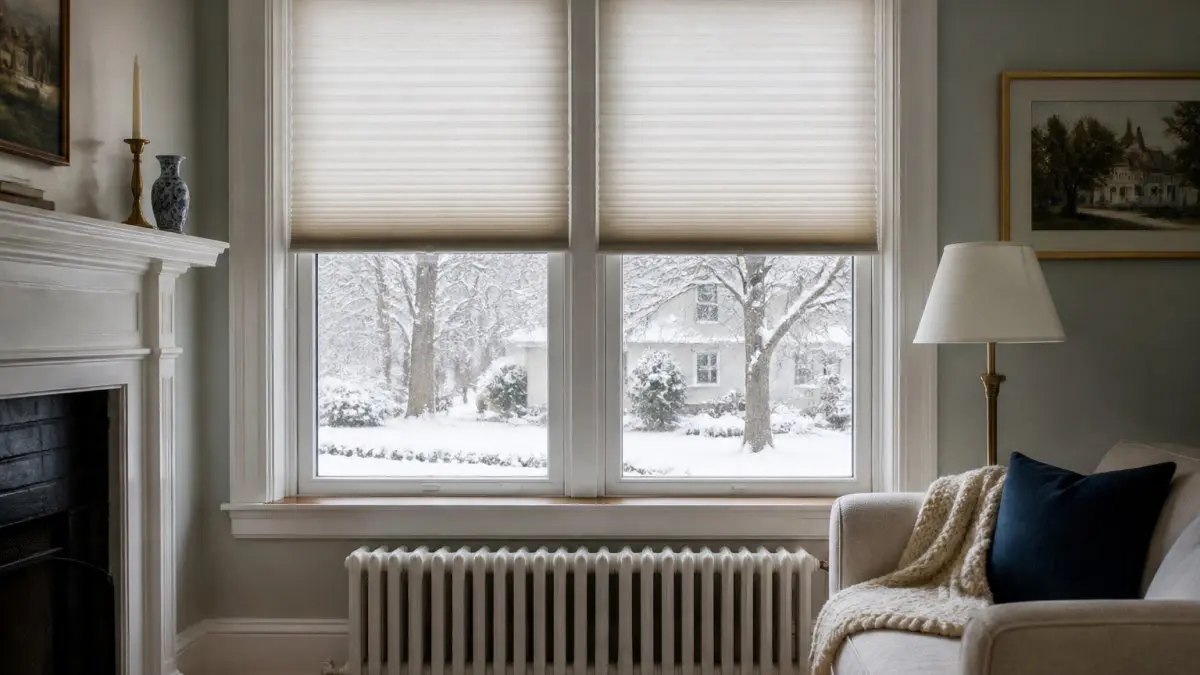
How Honeycomb Cells Trap Air and Slow Heat Transfer
The cell size and number of layers determine performance. Single-cell shades suit mild rooms. Double- and triple-layer cellular shades add more trapped air and are the versions worth specifying when heating costs are the concern (Constellation energy-efficient window coverings guide). A common mistake is buying a single-cell shade for a north-facing bedroom and expecting a measurable difference. Match the layer count to the exposure, not the sale price.
On double-hung windows, mount cellular shades as close to the glass as the frame allows. Every inch of gap between fabric and pane gives rising warm air somewhere to escape, and a tight inside mount outperforms a loose outside mount in the same room.
Insulating Window Shades: What the Department of Energy Data Shows
Insulating window shades are window coverings built with extra layers or cellular construction specifically to reduce heat flow through glass. The federal data backs the category rather than any single brand. The Department of Energy factsheet comparing window attachments against vinyl blinds puts the annual HVAC savings at 15%, which is the figure we use when a homeowner asks whether shades genuinely pay back (DOE window attachments factsheet).
What the factsheet does not promise is a fixed number for your house. Savings depend on window condition, how tight the shade fits, and how consistently it stays closed during peak heat and peak cold. Research from the Illinois Institute of Technology found that pairing insulating shades with automated control shows potential for significant energy savings, which tells you the schedule matters as much as the product (Illinois Tech automated shade study).
Window Coverings to Reduce Heat Loss in Older Homes
Window coverings to reduce heat loss matter most in pre-war housing stock, where single-pane glass and original frames are common. There, the shade is only half the system; fit and air leakage decide whether it performs or just looks tidy.
We see this constantly in Brookline and Boston properties with arched, oversized, or uneven openings. A stock-size shade leaves edge gaps, and gaps undo the insulation. Custom measurement is not a luxury in an antique home; it is the difference between a working thermal barrier and a decorative panel.
Fit, Air Leakage, and Hard-to-Reach Windows
Three details drive real-world performance:
- Side channels: Tracked edges hold the shade against the frame and cut the air path around the fabric.
- Sill coverage: The shade should overlap the sill and header, not stop short of them.
- Frame condition: Cracked glazing putty and worn weatherstripping leak regardless of what hangs in front of them.
If a window sits above a stairwell or high on a second-floor wall, add motorized operation to the list before you order. A shade you cannot reach is a shade that stays open during the coldest week of the year.
Motorized Shades for Energy Efficiency and Hard-to-Reach Windows
Motorized shades for energy efficiency solve a behavior problem, not just a convenience one. Insulation value depends on lowering the shade at the right hours, and manual shades on tall windows rarely get that discipline. Automated shades run on a schedule, closing at dusk in January, dropping during afternoon sun in July, without anyone climbing a ladder.
We fit motorized options for two-story foyers, arched transoms, and windows behind furniture. The gain is consistency; the limitation is cost, since hard-wired installation is more involved than a battery-powered retrofit. Where a window is easy to reach, a manual cellular shade delivers most of the insulation benefit for less.
Do not motorize a shade that was measured poorly. Automation makes a loose-fitting shade open and close on time, not seal any better. Fix the fit first, then add the motor.
Solar and Roller Shades: Managing Sunlight and Summer Heat Gain
Solar shades and roller shades handle the warm-weather half of the problem through a different mechanism than cellular shades.
The performance lever on a solar shade is openness, expressed as a percentage. A 1% openness fabric is a tight weave blocking most of the view and solar gain; a 14% openness fabric keeps a clearer view but passes more heat and light.
Color matters more than most buyers expect. Light fabrics reflect more solar energy; dark fabrics absorb more and can re-radiate some inward. On a west-facing window with no exterior shade, a light-faced solar fabric typically outperforms a dark one at the same openness, a general pattern, not a guarantee for every room.
Roller shades appear on the same energy-efficiency lists as cellular shades, though with less insulating structure (Constellation window covering comparisons). A standard roller shade with an opaque or room-darkening fabric reduces solar gain and glare, but it has no cellular air pocket, so its winter insulation value is limited.
Manufacturer guidance reports solar shades blocking up to 99% of UV rays along with a 10-25% reduction in overall energy consumption (3 Day Blinds window treatment guidance).
On east- and west-facing windows, the sun angle is low in the morning and late afternoon, so a solar shade mounted close to the glass and deployed during those hours does more good than a shade left half-raised. On south-facing windows the sun is high at midday, so a shorter valance or an exterior overhang can supplement the shade.
The practical rule: solar shades control solar heat gain and glare, while cellular shades control conductive heat loss. A south-facing living room with strong afternoon sun benefits from solar fabric in July and a cellular or layered shade in January. One product rarely does both jobs well, and pretending otherwise wastes money.
Shutters, Blinds, and Roman Shades: How They Compare
Shutters, blinds, and Roman shades each earn a place, but none leads on insulation. Plantation shutters offer solid light blocking and a permanent fit with fine louver control, but louver gaps leak air unless the frame is tight. Vertical blinds suit sliders but do little for heat transfer. Roman shades bring fabric and a tailored look, with insulation depending heavily on lining and frame fit.
Our view: specify shutters where durability and street-facing style matter, Roman shades where a room needs softness and light filtering, and cellular shades where the heating bill is the actual problem. A whole-house project usually mixes all three, room by room.
Costs, Payback, and Choosing Room by Room
No honest cost answer exists without a measurement, since pricing depends on window size, fabric, layer count, motorization, and quantity.
Pricing depends on window size, fabric, layer count, motorization, and quantity. Custom measurement and professional installation are built into our service.
Payback works the same way. The Department of Energy’s 15% figure for window attachments versus vinyl blinds gives you a planning benchmark, not a guarantee (DOE window attachments factsheet).
Check incentives before you buy. Rules and eligible products change, so confirm current eligibility with the manufacturer, your utility, or a qualified installer before assuming a credit or rebate applies.
A room-by-room approach we recommend:
- Bedrooms, north-facing: double- or triple-cell cellular shades, tight inside mount.
- Living rooms, south- or west-facing: solar shades for summer, layered cellular for winter.
- Bathrooms and kitchens: moisture-tolerant fabrics with easy cleaning.
- Hard-to-reach windows: motorized shades on a schedule.
- Street-facing rooms: plantation shutters or Roman shades for style and privacy.
If resale is on your horizon, custom-fit treatments read as finished, maintained rooms to buyers and photograph well. They are not a renovation-grade return, and we tell sellers that plainly. The stronger financial case for shades is the ongoing utility bill, not the resale premium.
Frequently Asked Questions
Do cellular shades actually keep heat out in summer and cold out in winter?
Yes, the honeycomb construction is the reason. Cellular window shades trap air in their insulating cells, which slows heat transfer through the glass. A U.S. Department of Energy factsheet reports that window attachments can save about 15% of a household’s annual HVAC energy use compared with vinyl blinds. Double- and triple-layer cellular shades add more air pockets and more insulation. In practice, the biggest gains come from a custom fit with minimal gaps, so professional measuring matters as much as the fabric itself.
Should insulating window shades stay closed during winter days?
Open them on south-facing windows during sunny winter days to let solar heat in, then close them at dusk to hold that warmth overnight. On north-facing windows, keep insulating window shades closed during cold snaps. The pattern matters more than the product: shades left open after sunset lose much of their benefit. Automated or motorized shades can handle this schedule for you, which is especially useful for hard-to-reach second-floor windows where manual adjustment gets skipped.
Are motorized shades for energy efficiency worth the extra cost?
They can be, for two reasons. First, automation removes the human error factor: shades adjust on schedule whether you are home or not, so insulating shades actually get closed at dusk in January. Second, research from the Illinois Institute of Technology found that insulating window shades connected to automated controls showed potential for significant energy savings. Pricing depends on window count, motor type, and control options, so request a quote for your specific windows rather than relying on generic estimates.
Which window coverings reduce heat loss best in an antique home with irregular windows?
Custom fabrication is the deciding factor. Old arched, oversized, or out-of-square windows leak air around the frame, and a ready-made shade with gaps defeats the insulation. Cellular and quilted roller shades made to exact measurements, ideally mounted with side channels or a tight outside mount, limit that leakage. For unusual shapes, a specialist can template the opening. Pair the shades with weatherstripping and caulking for the full effect, since shades address the glass and frame, not gaps in the wall itself.
How much do energy efficient window shades cost, and will they pay back?
Pricing depends on window size, fabric, lift system, and whether you add motorization, so there is no single figure that applies. Payback comes from two directions: lower heating and cooling costs over time, and resale appeal if you sell. Custom treatments also protect interiors from UV damage. For a realistic number on your home, get an in-home measurement and quote rather than comparing online list prices for stock sizes.
