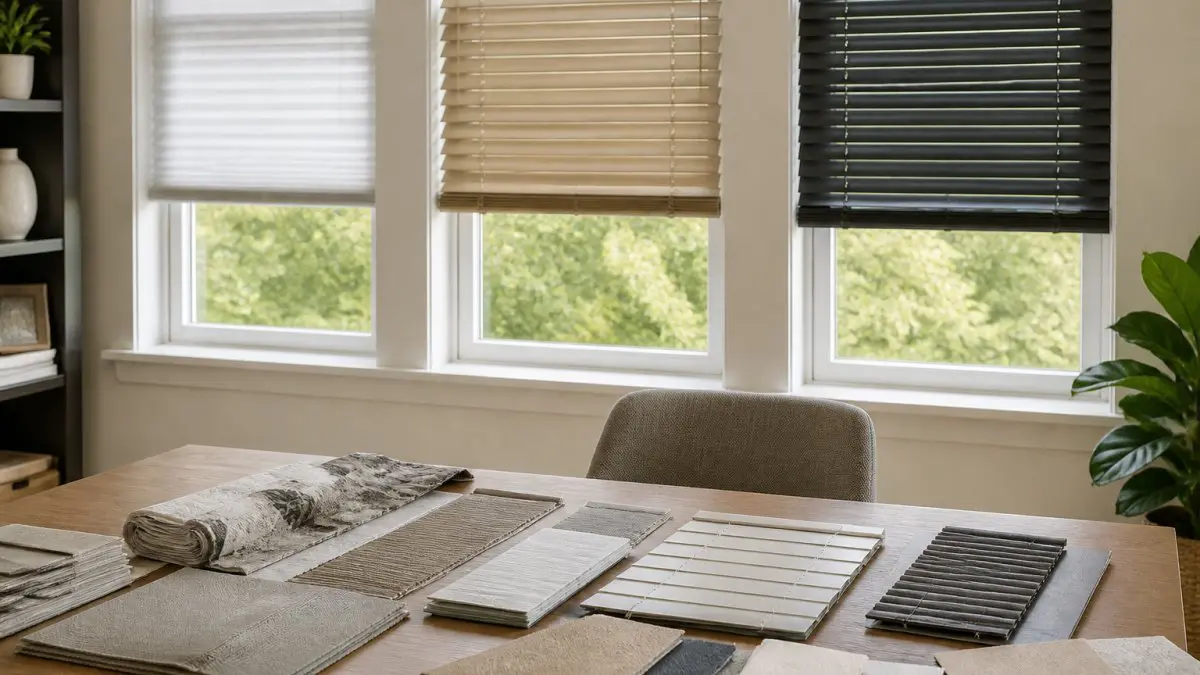
Innuwindow Alternative for Custom Blinds: 2026 Guide
Table of Contents
- Why Homeowners Seek an Innuwindow Alternative for Custom Blinds
- Custom Blinds Alternatives: A Side-by-Side Comparison
- Custom Roller Shades: Clean Lines and Simple Light Control
- Roman, Zebra, and Panel Track Options for Wide Windows and Sliding Doors
- Motorized Window Treatments for Hard-to-Reach Windows
- Custom Window Treatment Installation: Measuring, Mounting, and Fit
- Pricing, Warranty, and Support: What to Ask Before You Buy
- Frequently Asked Questions
Last Updated: October 19, 2026
Why Homeowners Seek an Innuwindow Alternative for Custom Blinds
Shopping for custom blinds online sounds simple until the box arrives and the fit is off by half an inch. That gap is why so many homeowners seek an Innuwindow alternative for custom blinds: they want customization without the uncertainty of a self-measured, self-installed order.
Online sellers compete on price and speed; local specialists compete on fit, installation, and the willingness to come back when something goes wrong.
Custom Blinds Alternatives: A Side-by-Side Comparison
Custom blinds is a broad category, and the alternatives differ far more than most buying guides admit. Each style below solves a specific problem, so match the product to your window before comparing prices. This section also compares the two ways people buy custom blinds, a self-measured online order versus a measured-and-installed local order, because that choice drives fit, cost, and support.
Quick Comparison Table
| Option | Best For | Light Control | Typical Mount | Maintenance |
|---|---|---|---|---|
| Roller shades | Clean modern rooms, easy operation | Good, room-darkening available | Inside mount | Wipe clean |
| Roman shades | Living rooms, layered fabric look | Moderate to good | Inside or outside | Vacuum gently |
| Zebra (dual-layer) shades | Versatile day-to-night control | Adjustable bands | Inside mount | Dust regularly |
| Panel track blinds | Sliding doors, very wide glass | Good, glides aside | Ceiling or wall | Wipe clean |
| Cellular (honeycomb) shades | Energy efficiency, insulation | Soft, diffused | Inside mount | Vacuum with brush |
| Faux wood or horizontal blinds | Kitchens, bathrooms, moisture | Strong, tilt adjustable | Inside mount | Damp wipe |
| Vertical blinds | Patio doors, floor-to-ceiling glass | Good, tilt and stack | Ceiling or wall | Wipe clean |
Style-by-Style: What Each Alternative Actually Solves
Roller shades. One panel, one lift mechanism, and a slim profile that tucks into the frame.
Roman shades. Fabric-forward rooms get soft stacked folds and warmth a flat roller cannot provide.
Panel track blinds. A standard shade on a patio door gets in the way every time someone walks through.
Faux wood and horizontal blinds. Kitchens, bathrooms, and laundry rooms need moisture tolerance and easy cleaning.
Vertical blinds. Still the workhorse for patio doors and floor-to-ceiling glass.
Online Order vs. Local Measured-and-Installed Order
This is the comparison that actually matters for an Innuwindow shopper. The two paths differ on five dimensions:
| Dimension | Self-measured online order | Local measured-and-installed order |
|---|---|---|
| Who measures | You, from a guide | A specialist on site |
| Who installs | You, or a hired handyman | The provider’s installer |
| Fit risk | Yours if the measurement is off | The provider’s |
| Custom sizing range | Usually capped at listed widths | Built to the opening, including arches and out-of-square frames |
| Support after install | Call center, email, or portal | One local contact for repairs and adjustments |
| Lead time | Often shorter for stock-adjacent sizes | Longer, because each unit is built to measure |
A 1920s arched window, a bay with three different widths, or a sliding door with a handle that needs clearance is where the local path earns its premium. The more unusual the opening, the more measurement and installation are worth paying for.
Before you compare quotes, write down the window’s width, height, mount type, and any obstruction (crank, handle, tilt-in sash). Every provider, online or local, will ask for the same four things, and having them ready is what makes quotes comparable.
How to Choose Between the Alternatives
Work in this order: (1) identify the window type and any obstruction, (2) pick the style that solves that window’s problem, (3) decide inside versus outside mount, (4) choose fabric or material for light control and moisture, and only then (5) compare providers on measurement, installation, and support.
Custom Roller Shades: Clean Lines and Simple Light Control
Roller shades offer simplicity. One panel, one pull, no cords to tangle, and a profile that disappears into the window frame.
A light-filtering weave softens afternoon glare while keeping the room bright. A room-darkening backing blocks light for bedrooms and media rooms. The same roller mechanism serves both, so the decision is really about fabric, not hardware.
Cordless and motorized lift options also matter in homes with young children or pets, since cordless operation removes a common safety concern.
Roman, Zebra, and Panel Track Options for Wide Windows and Sliding Doors
Fabric-forward rooms call for Roman shades, which stack into soft folds and add warmth a flat roller cannot.
Sliding doors are a different problem entirely. A standard shade on a patio door gets in the way every time someone walks through. Panel track blinds glide horizontally on a track, stacking neatly to one side.
Custom size matters most here. A sliding door measured to the frame, with the track mounted to clear the door handle, works. A stock size almost never does.
Motorized Window Treatments for Hard-to-Reach Windows
Motorized window treatments are shades or blinds with an integrated motor, controlled by remote, wall switch, or app.
Modern motorized systems from established manufacturers are built for daily use, so the practical concerns are power and planning rather than durability.
Cost is the honest caveat. Motorization adds to the price of any custom shade, and the premium varies by system and window count. We quote each project individually rather than publish a number that will not hold.
Do not motorize a window you have not measured properly. A motorized shade that binds against the frame will strain the motor, and the repair cost lands on you, not the manufacturer.
Custom Window Treatment Installation: Measuring, Mounting, and Fit
Custom window treatment installation decides whether the whole purchase works. Measure the window in three places for width and three for height, take the narrowest width and longest height, and decide inside versus outside mount before ordering.
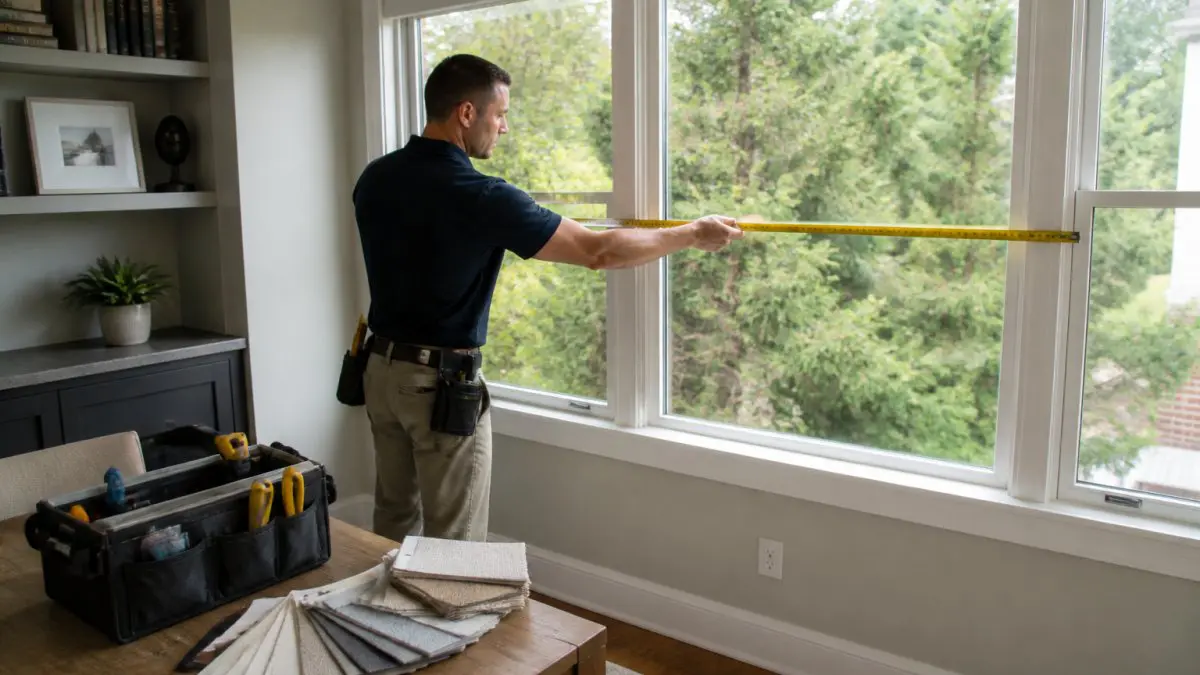
The mistakes we see most often:
- Measuring the glass instead of the frame opening
- Ignoring a tilt-in window or a crank that needs clearance
- Ordering an inside mount for a frame that is out of square
- Forgetting that baseboards and sills change the drop
Professional measuring removes the redo risk entirely. If a specialist measures and the shade does not fit, that is the specialist’s problem, not yours, the strongest argument for a local provider over a self-measure online order.
Pricing, Warranty, and Support: What to Ask Before You Buy
Here is what drives the price of a custom blind, plus the questions and total-cost framework to compare providers fairly.
What Drives the Price of a Custom Blind
Five factors move the number more than anything else:
- Dimensions. Price scales with square footage, but not linearly. A very wide window needs a stronger roller tube or heavier headrail, and that specification jump costs more than the extra width alone.
- Material and fabric. A basic light-filtering polyester weave sits at the low end; linen blends, woven woods, and room-darkening backings sit higher. Faux wood and aluminum horizontals are usually the lowest cost per square foot among the styles in this guide.
- Operating mechanism. Cordless lift, continuous-loop lift, top-down/bottom-up, and tilt mechanisms each add cost. Motorization adds the most, and the premium varies by system and by how many windows share a remote or hub.
- Mount and frame complexity. Inside mount is usually the simplest. Outside mount, ceiling mount for panel tracks, and any cutout for a crank or handle add fabrication and hardware.
- Quantity and room grouping. Ordering several windows at once often reduces the per-unit price because measuring, fabrication setup, and installation travel are shared.
We quote each project individually rather than publish a number that will not hold, because two windows of the same size can land at different prices once mechanism and mount are chosen.
Total Cost of Ownership, Not Sticker Price
A fair comparison adds four costs the sticker price hides:
- Measuring. Free with some providers, a line item with others. Ask explicitly.
- Installation. Often quoted separately. A self-installed order shifts labor to you or to a hired handyman.
- Redo risk. If a self-measured custom shade arrives wrong, the replacement is usually on you, and custom goods are rarely returnable for a measuring error. That risk has a dollar value even though it never appears on an invoice.
- Service over time. Repairs, re-tensioning, and motor replacement are where the cheapest up-front option can become the most expensive in year three.
Compare total cost of ownership, not sticker price. Measuring, installation, and a repair path are part of what you are buying.
Warranty: What to Confirm in Writing
Warranty terms for custom window treatments vary widely, so read the document rather than the marketing page. Confirm these points:
- Coverage period for the fabric or material versus the mechanism. They are often different.
- Motor coverage. Motorized systems frequently carry a shorter warranty than the shade itself. Ask for the motor term separately.
- What voids coverage. Improper measurement, self-installation, and modification are common exclusions. If you plan to install yourself, confirm the warranty still applies.
- Who performs the repair. Manufacturer depot, a local dealer, or the retailer. This determines how long a repair takes and whether you pay shipping.
- Service-visit charges. Some warranties cover parts but not the trip. Ask whether a service visit is billed.
Returns and Lead Times on Custom-Sized Products
Custom products are made to your measurements, so return policies are typically stricter than for stock items, often limited to manufacturing defects rather than fit or color preference. That is exactly why fit accuracy matters so much. Before ordering, confirm:
- The return window and what qualifies as a defect versus a measuring error.
- Whether a remake is offered at a discount if the measurement was off.
- The lead time from order to install, and whether it is quoted in business days or calendar days.
- Whether lead time changes for motorized or wide units.
The Five Questions to Ask Every Provider
- Is measuring and installation included, or quoted separately?
- What is the warranty period, and does it cover motors and mechanisms?
- Who performs repairs, and is there a charge for a service visit?
- What is the return policy on a custom-sized product?
- How long is the lead time from order to install?
A local provider who also handles repairs gives you one contact for the life of the product. The point is that the comparison is only honest once measuring, installation, redo risk, and service are on the same side of the ledger.
Frequently Asked Questions
What are the best alternatives to Innuwindow for custom blinds?
Shoppers comparing options for custom blinds usually weigh local dealers, online made-to-measure retailers, and big-box stores. Local specialists offer in-home measuring, professional custom window treatment installation, and repair support after the sale. Online sellers often cost less upfront but leave measuring and mounting to you. Before choosing, confirm the provider handles inside mount fit, custom sizes for wide windows, and warranty service. Request a written quote so you can compare materials, lift systems, and support like for like.
How do I compare custom blind companies fairly?
Compare on five points: measuring method, product range, installation, warranty, and total cost. Ask whether measuring is done in person or self-reported, since window dimensions drive fit and light gaps. Confirm who installs the blinds and whether repairs are covered. Get itemized quotes that list materials, finishes, cordless or motorized upgrades, and any trip fees. A like-for-like comparison of custom blind providers should include the same window sizes and product lines, otherwise the price difference is misleading.
Are custom blinds worth the cost compared with ready-made options?
Custom blinds are cut to your exact window dimensions, which matters for wide windows, arched openings, and sliding doors where stock sizes leave gaps and light leaks. They also let you choose light filtering levels, privacy coverage, and cordless or motorized lift systems. Ready-made shades cost less but rarely fit unusual openings well. Pricing depends on window count, fabric, and features, so request a quote from a local dealer to see the real number for your home before deciding.
Can custom blinds and shades be motorized?
Yes. Motorized window treatments are available for roller shades, Roman shades, and horizontal blinds, and they suit high or hard-to-reach windows where a cord is awkward or unsafe. Motorized options run on battery or low-voltage power and can be controlled by remote, wall switch, or smart-home apps. Ask about reliability, battery life, and repair coverage before buying. Motorization adds to the cost, so confirm the upgrade price in writing along with the rest of your quote.
The real challenge with an Innuwindow alternative for custom blinds is not finding a cheaper option. It is finding one that fits your windows the first time and stands behind the result. Carroll Shade has served Boston and Brookline homeowners since 1932 as a family-owned, Hunter Douglas authorized partner, offering custom design, professional installation, motorized options, and ongoing blind repair. Contact us to schedule a measure and get a quote built around your windows.
