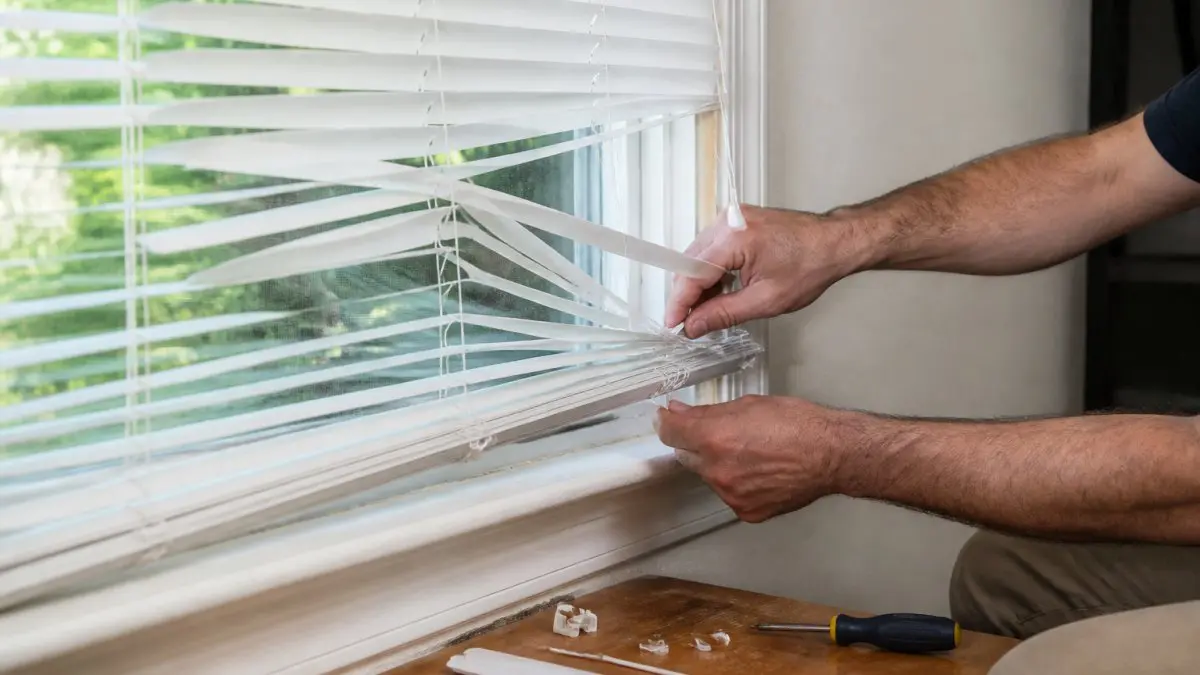
Can Broken Window Blinds Be Repaired? A Complete Guide
Table of Contents
- Can Broken Window Blinds Be Repaired? Yes, Here’s How
- What You’ll Need Before You Start
- How to Fix Broken Blinds: Step-by-Step
- Diagnosing Blinds Not Opening or Closing
- How to Replace a Broken Blind Slat
- Repair or Replace Blinds: Making the Right Call
- Safety Precautions and When to Call a Professional
- Conclusion
- Frequently Asked Questions
Last Updated: October 16, 2026
Can Broken Window Blinds Be Repaired? Yes, Here’s How
Yes, most broken window blinds can be repaired, and often for far less than the cost of new ones. The catch is that the fix depends on what actually broke. A snapped lift cord is a different job than a bent slat or a dead tilt mechanism.
At Carroll Shade, we’ve handled window treatments for homeowners in the Boston and Brookline area since 1932. In that time, we’ve learned that the question “can broken window blinds be repaired?” almost always has the same answer: yes, if you diagnose the problem first.
Here’s what most guides get wrong. They jump straight to a fix without identifying the fault. That’s how a simple cord swap turns into a stripped headrail.
Below, we’ll walk you through each repair type, the tools you need, and when to stop and call a pro.
What You’ll Need Before You Start
Gather your tools first so you’re not hunting mid-repair. Most fixes need only a few basic items.
- Needle-nose pliers
- Scissors
- Replacement lift cord or ladder strings
- New slats (matched to your blind type)
- Small screwdriver
- Cord lock or tilt mechanism parts
- Step stool or ladder
Check the brand and model on your headrail before buying parts. A 2-inch faux-wood blind takes different slats than a 1-inch aluminum one. Parts compatibility matters more than most people expect.
Photograph the headrail label before you start. That model number is the fastest way to get the right replacement parts on the first try.
How to Fix Broken Blinds: Step-by-Step
The repair method depends on the failure. Before you touch a tool, run the symptom through this diagnosis path. It takes about a minute and keeps you from fixing the wrong part.
Diagnosis by symptom and blind type
| Symptom | Most likely cause | First check |
|---|---|---|
| Cord pulls but slats don’t move | Broken cord lock or snapped lift cord | Look at the cord lock inside the headrail |
| Slats won’t tilt, wand spins freely | Stripped tilt gear or cracked wand | Remove the headrail cover and inspect the gear |
| One slat sags or won’t lie flat | Bent or broken slat | Tilt slats flat and sight down the row |
| Blind lowers on one side only | Uneven or broken ladder string | Compare both ladder strings at the bottom rail |
| Nothing moves, cord is tight | Jammed cord lock or tangled cord | Do not pull harder, release tension first |
Work through the table in order. The cheapest, simplest fix is almost always the right first stop.
Fixing Blinds That Won’t Raise or Lower
A blind that won’t raise usually has a jammed or snapped lift cord. Sometimes it’s the cord lock. Corded blinds use a cord lock that grips the cord when you release it; when that lock wears out, the cord slides freely and the blind drops.
- Lower the blind fully and remove it from the brackets.
- Cut the damaged cord above the fray.
- Thread the new cord through the cord lock and headrail.
- Run it down through each slat and the bottom rail.
- Tie off at the bottom rail and test the raise and lower action.
If the cord is intact but the blind still won’t hold, replace the cord lock rather than the cord. Match the lock to your headrail width, a 1-inch lock will not seat in a 2-inch headrail.
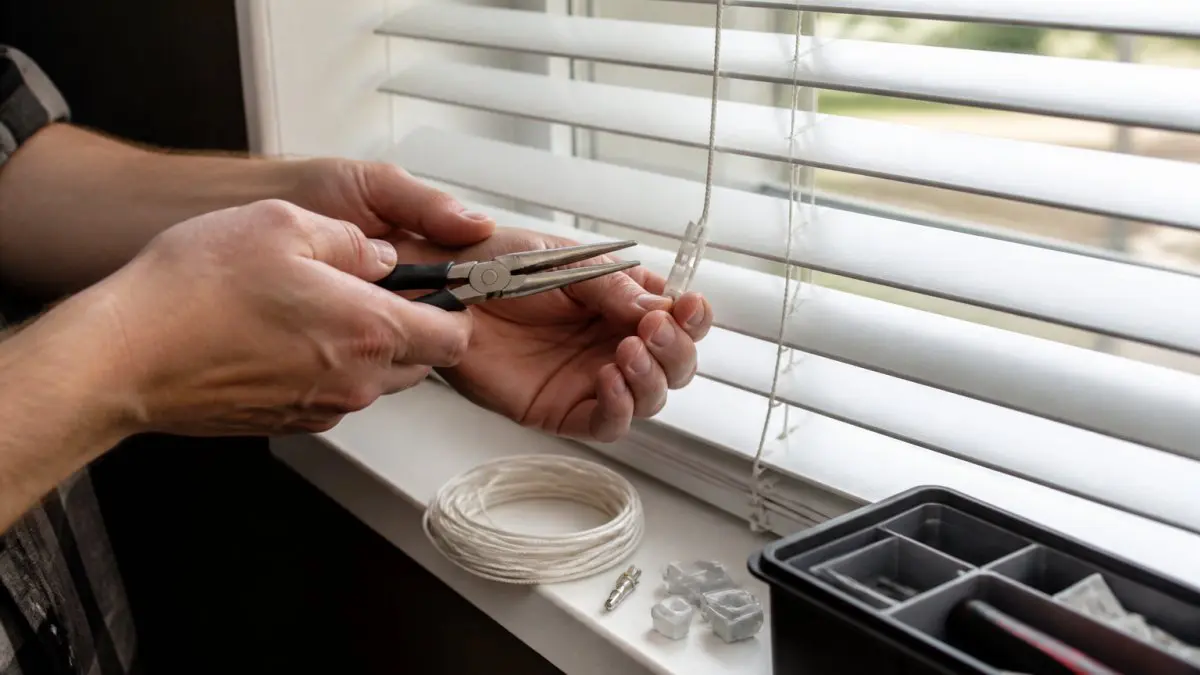
Repairing a Broken Tilt Mechanism
When slats won’t tilt, the tilt mechanism or its gears have failed. On many built-in blinds, the wand connects to a gear that strips over time.
Remove the headrail cover to expose the tilt gear. If the gear is stripped, replace it. If the wand itself is cracked, a new wand is often the whole fix. Tilt wands are usually sold by length and connector type, so measure the old wand before ordering.
Repairing Cordless and Motorized Blinds
Cordless and motorized blinds hide their mechanisms inside the headrail. Cordless models rely on a spring or tension system, and motorized models add a motor and control board. Opening either can void a warranty and damage sensitive parts.
- Cordless: If the blind won’t stay up, the tension spring has likely lost its set. This is usually a manufacturer or technician fix, not a DIY one.
- Motorized: If the blind won’t respond, check the battery pack or power supply and the remote pairing before assuming the motor failed. If those check out, the issue is internal.
Never force a stuck blind. Pulling hard on a jammed cord can snap the headrail mounts, turning a small repair into a full replacement. If a repair has failed twice, stop, repeated attempts often damage the headrail.
Corded blinds also carry a child-safety concern (Window Covering Cords). Loose or looped cords are a strangulation risk for young children (Window Covering Cords). If you have young children or pets, choose cordless or motorized options, or use a cord tensioner and keep cords secured out of reach.
Diagnose by symptom first, then repair only the failed part. Cord and tilt fixes are DIY-friendly; cordless and motorized internals are not.
Diagnosing Blinds Not Opening or Closing
Start with the symptom, not the part. Blinds not opening or closing point to one of three culprits: the cord, the tilt, or the slats themselves.
| Symptom | Likely Cause | Fix |
|---|---|---|
| Won’t raise or lower | Snapped or jammed lift cord | Restring the cord |
| Won’t tilt | Stripped tilt gear or wand | Replace gear or wand |
| Slats sag or stick | Bent or broken slats | Replace slats |
| Cord pulls but nothing moves | Broken cord lock | Replace cord lock |
Work through this list in order. The cheapest, simplest fix is almost always the right first stop.
Never force a stuck blind. Pulling hard on a jammed cord can snap the headrail mounts, turning a small repair into a full replacement.
How to Replace a Broken Blind Slat
Replacing a single slat is one of the easiest home repairs you can do. You don’t need to take the whole blind down.
- Lower the blind and tilt slats flat.
- Pop the bottom rail caps off.
- Slide the damaged slat out through the ladder strings.
- Thread the new slat in along the same path.
- Re-seat the bottom rail and test the tilt.
Match the slat width and color exactly. A 2-inch faux-wood slat won’t fit a 1-inch frame, and mismatched color is obvious in daylight.
Most slat damage is cosmetic and cheap to fix. Save full replacement for cases where the headrail or multiple cords have failed.
Repair or Replace Blinds: Making the Right Call
Repair wins when one part failed and the rest is sound. Replace when the damage is structural or widespread. The hard part is the middle ground, so use cost, time, and condition together rather than a single rule.
Compare the three paths
| Path | Typical cost | Time | Best when |
|---|---|---|---|
| DIY repair | Parts only, often a few dollars to about $30 for cord, slats, or a wand | 30-90 minutes | One part failed, blind is otherwise sound |
| Professional repair | Service call plus parts; varies by market and blind type | Scheduled visit | High or hard-to-reach windows, motorized or cordless internals |
| Replacement | Cost of a new blind plus installation | Same day to a few weeks | Headrail cracked, multiple cords failed, or parts discontinued |
These are ranges, not quotes. Get a local estimate before committing, because labor rates and part availability vary widely.
Use these thresholds
- If the repair cost approaches half the price of a comparable new blind, and the blind is already old, replacement usually makes more sense.
- If the blind is newer and a single part failed, repair is the clear choice.
- If parts are discontinued, replacement is often the only realistic option.
- If the headrail is cracked or bent, replacement is usually the better call, a new headrail often costs more than a new blind.
Weigh these factors
- Age of the blind
- Number of failed parts
- Whether parts are still available
- Type of blind (faux-wood and 2-inch blinds are often repairable)
- Your time and comfort with DIY repair
- Whether the window is high, hard to reach, or motorized
For homeowners preparing to sell, working blinds matter. Buyers notice broken window treatments, and a single failed cord can read as general neglect.
Before you decide, price the exact replacement part and a comparable new blind. If the part is hard to find or the new blind is close in price, replacement saves time and frustration.
Repair when one part failed and parts are available. Replace when the headrail is damaged, multiple cords failed, or parts are discontinued. Use the half-price rule as a starting point, not a verdict.
Safety Precautions and When to Call a Professional
Some repairs are safe for anyone with basic tools. Others aren’t.
Call a professional when:
- The blind is mounted high or hard to reach
- The headrail itself is cracked or bent
- The blind is motorized or cordless with internal mechanisms
- You’ve tried a repair and it failed twice
Cordless and motorized blinds hide their mechanisms inside the headrail. Opening them can void a warranty and damage sensitive parts. That’s a job for a trained technician.
For hard-to-reach or motorized windows, professional service is usually faster and safer than a ladder and guesswork.
Conclusion
A broken blind rarely means a full replacement. Most issues, from snapped cords to bent slats, are fixable with basic tools and the right parts. The key is diagnosing the fault before you start.
If you’d rather not climb a ladder or wrestle a headrail, Carroll Shade can help. We offer stress-free repair services for damaged or malfunctioning blinds, plus expert installation and custom Hunter Douglas designs. As a family-owned business serving the area since 1932, we stand behind our work.
Contact Us to schedule a repair or explore new window treatments that fit your home.
Frequently Asked Questions
Can you replace a single broken blind slat?
Yes, you can replace a single broken blind slat on most standard 2-inch blinds. First, identify the exact slat size and material (faux-wood, vinyl, or aluminum). Remove the bottom rail and slide out the damaged slat. Thread the new slat onto the ladder strings and reattach the bottom rail. Replacement slats are available from the original manufacturer or aftermarket suppliers. If the slat is part of a built-in or cordless system, check compatibility before ordering.
Is it cheaper to repair or replace blinds?
For minor issues like one bent slat or a frayed cord, repair is often more cost-effective than replacement. However, if the headrail is cracked, the tilt mechanism is stripped, or multiple cords have snapped, replacement may be the better option. Labor for professional repair varies, so it’s always best to get a quote before deciding.
How do you fix blinds that will not open or close?
Start by checking the tilt mechanism and cord lock. If the wand or cord spins freely without moving the slats, the tilt gear may be stripped. For corded blinds, inspect the cord lock for debris or a jammed cord. You can often free a stuck cord by gently pulling it at an angle. If the lift cords are tangled inside the headrail, you’ll need to remove the headrail and restring. For cordless or motorized blinds, check the battery or power source first.
When should you call a professional to repair blinds?
Call a professional if the repair involves restringing multiple cords, replacing a headrail, or working with motorized or cordless systems that are still under warranty. DIY attempts on complex mechanisms can void warranties or cause further damage. Also, if your blinds are part of a custom window treatment installed by a local company, they may offer repair services. For antique or uniquely sized windows, a professional can source compatible parts and ensure a proper fit.
