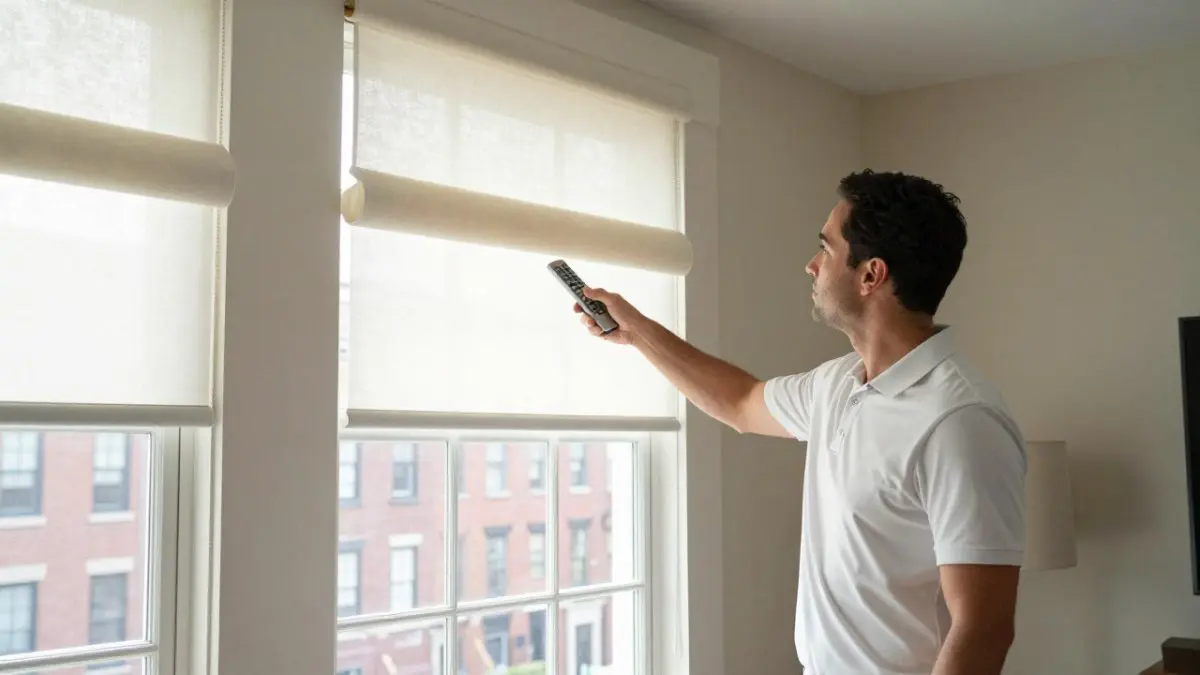
Motorized Shades With Remote Control: 7 Options Compared
Quick Summary
Motorized shades with remote control let you raise, lower and adjust window coverings without a cord. Battery, rechargeable and hardwired motors are the main power options, and each affects installation, maintenance and what happens during a power outage.
- Battery and rechargeable motors keep working during a power outage; hardwired motors generally stop without battery backup.
- Hardwired motors suit new construction or renovations where wiring is already being run.
- Check the motor’s rated lift capacity against the finished shade weight before ordering.
- Ask whether the remote pairs directly with the motor or routes through a hub.
- Comparing a DIY retail price to a dealer quote is not like for like, so confirm what each price includes.
Table of Contents
- Motorized Shades With Remote Control: 7 Options Compared
- Why Motorized Shades With Remote Control Are Worth Considering
- How We Evaluated These Motorized Shade Options
- Smart Blinds Pros and Cons: What to Weigh Before You Buy
- Battery Operated vs Hardwired Motorized Shades
- Motorized Blinds for Large Windows and Hard-to-Reach Spots
- Side-by-Side Comparison of Remote-Controlled Options
- Choosing the Right Remote-Controlled Shade and Booking Your Measurement
- Frequently Asked Questions
Motorized Shades With Remote Control: 7 Options Compared
Last Updated: November 10, 2026
Why Motorized Shades With Remote Control Are Worth Considering
Motorized shades with remote control let you raise, lower and adjust window coverings without reaching for a cord. For homes with tall windows, skylights or hard-to-reach spots, that convenience changes how often people actually use their blinds. Carroll Shade has served Boston and Brookline homeowners since 1932, and offers motorized options.
The category is also expanding. Global Market Insights values the automated window blinds market at USD 2.06 billion in 2025 and projects USD 2.25 billion in 2026 (Global Market Insights, Automated Window Blinds Market Size report). Growth like that tends to bring more products, more control options and more confusion about what to buy.
Remote control is only one of several ways to operate these shades. Hunter Douglas describes control by remote, app, voice or a user-set schedule (Hunter Douglas motorized window treatment controls). Some motors also support smart-home standards. SmartWings says selected motor options offer Matter compatibility, scheduling and voice control (SmartWings motorized shade options).
Carroll Shade offers product selection, custom measurement, professional installation and repair, which is a useful combination for homeowners to consider.
How We Evaluated These Motorized Shade Options
We compared options on the criteria most homeowners care about: how the remote works, whether the shade can be installed as a custom fit, how the motor is powered, what smart-home features are included and what support comes after installation. We also looked at whether the product is sold through a dealer who can measure and install it.
Pricing for custom motorized window treatments depends on size, fabric, motor choice, quantity and installation, so the most reliable figure is a written quote from Carroll Shade.
We weighted remote control reliability and range heavily, because a remote that fails to reach the shade is a daily frustration. We also weighted serviceability, since motorized parts can need attention years after installation.
Smart Blinds Pros and Cons: What to Weigh Before You Buy
Smart blinds can be easier to operate from a chair, can open and close on a schedule, and can make tall or awkward windows more practical. Light control and privacy can be adjusted without a cord.
The drawbacks are equally practical. Motorized shades cost more than manual ones, and the motor adds a part that can fail. Batteries need charging or replacing, and smart-home features depend on hubs or apps that may change over time. Buyers should ask how the remote pairs, what happens during a power outage and who repairs the unit if something goes wrong.
For hard-to-reach windows and for households that adjust their shades often, the convenience can be worth the added cost. For a single small window that rarely changes, a manual shade may be the more sensible purchase.
Battery Operated vs Hardwired Motorized Shades
Power source is the decision most homeowners underestimate, because it affects installation cost, ongoing maintenance and what happens when the electricity or Wi-Fi goes down. The three practical choices are disposable batteries, rechargeable battery packs and hardwired motors.
Disposable batteries are the cheapest upfront and the simplest to swap, but they are also the easiest to forget. Battery life depends on shade size, daily cycles and motor efficiency; larger shades and heavier fabrics tend to drain batteries faster. Keep a spare set on hand and replace all cells at once rather than mixing old and new.
Rechargeable lithium packs are now common on retrofit-friendly motors. Rechargeable packs are available on some motors; check the manufacturer’s specifications for runtime and charging details. The trade-off is that you must remove the pack or run a charging cable to the shade, which is awkward on high windows. Some systems offer a solar panel accessory that can help keep the pack charged.
Hardwired motors draw from the home’s electrical system and never need a battery change. They suit new construction or renovations where an electrician is already running wire, and they are the better choice for very large or frequently used shades. Retrofitting hardwired motors into finished walls can involve additional wall repair and electrical work.
Battery life claims are typically measured at a modest daily cycle count, so heavier daily use may shorten battery life.
Outage behavior matters too. Battery and rechargeable motors keep working during a power outage because the motor and remote are self-contained. Hardwired motors generally stop unless the system includes a battery backup. Smart features are a separate layer: if the hub or Wi-Fi network is down, app and voice control fail, but a handheld remote that talks directly to the motor usually still works. Ask the seller specifically whether the remote pairs directly with the motor or routes through a hub, because that determines whether you can still operate the shade when the network is out.
A reasonable rule of thumb: choose battery or rechargeable for retrofits and hard-to-wire rooms, and choose hardwired for new builds, very large openings and shades you operate daily. Confirm the motor’s rated lift capacity against the finished shade weight before ordering, and get the charging method and expected runtime in writing.
Motorized Blinds for Large Windows and Hard-to-Reach Spots
Large windows and high second-floor windows are where motorization pays off most. Lifting a heavy shade by hand is tiring, and reaching a cord on a tall window is not always practical. A motorized shade lets you adjust it from the floor with one press of a handheld remote.
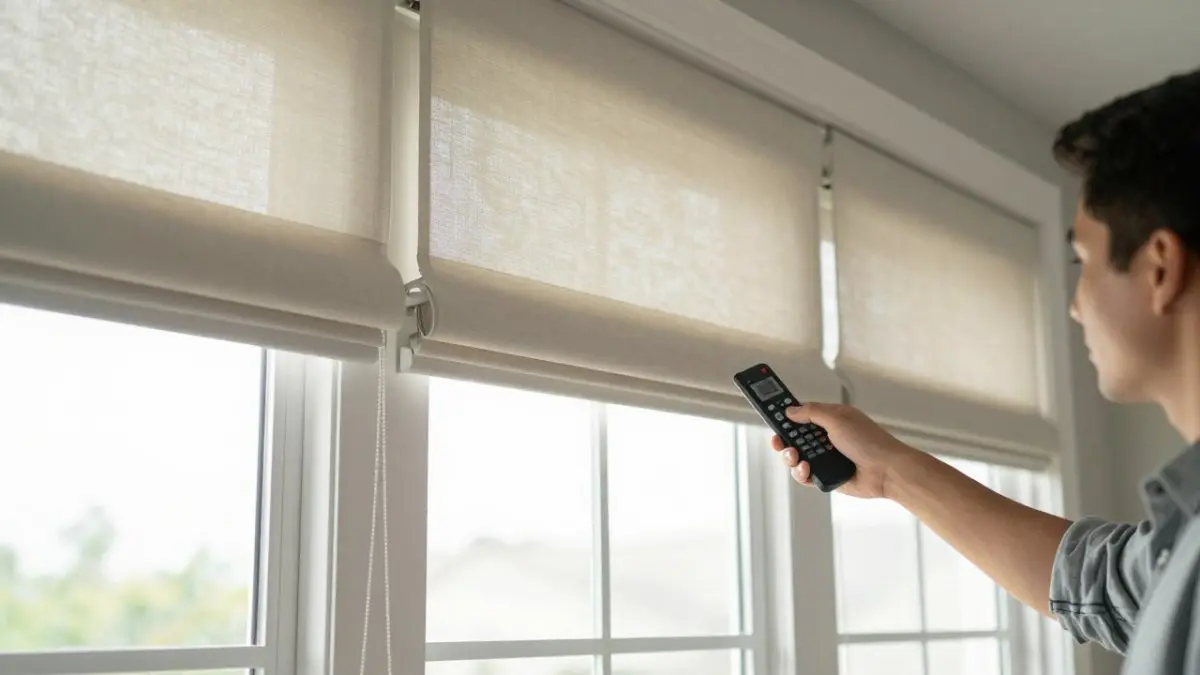
For large openings, check the motor’s rated capacity against the shade’s weight and width. Larger shades need stronger motors, and the installer should confirm the fit before ordering. This is one reason custom measurement matters.
Carroll Shade offers motorized window treatments for homes in the Boston area, with custom measurement available for each window.
Side-by-Side Comparison of Remote-Controlled Options
The table below compares the seven options on the criteria that actually change the buying decision: how the remote pairs, whether the motor is battery or hardwired, smart-home compatibility, custom sizing, and who handles installation and repair. Prices are shown only where a source published one; otherwise pricing depends on size, fabric and motor choice, and a quote is required.
| Option | Remote and Pairing | Power | Smart-Home Compatibility | Custom Sizing | Installation and Support | Starting Price | Best For |
|---|---|---|---|---|---|---|---|
| Carroll Shade | Motorized options with handheld remote; dealer-configured | Battery or hardwired depending on motor | Varies by motor selected | Yes, measured per window | Professional measure, install and repair | Contact for a quote | Full service, including later repair |
| SmartWings Motorized Light Filtering Roller Shades | Remote included; Matter-compatible motor option available | Rechargeable battery, solar panel accessory | Matter over Thread on select motors; scheduling and voice control | Yes | DIY install with support | About USD 370 for the size Wirecutter compared, including valance and solar panel; CNET notes the Matter over Thread motor adds USD 95 per blind | Smart-home connectivity on a mid-range budget |
| Remote included | Battery | Limited; remote-first | Yes | DIY | USD 116 | Lower-priced remote-controlled blinds for a single window | |
| Serena handheld remote; adjusts in small increments | Battery or hardwired | Works with major smart-home systems through Lutron | Yes | Dealer or DIY depending on channel | Contact for pricing | Precise handheld remote control | |
| Caseta remote and app | Battery | Caseta ecosystem | Yes | Dealer or DIY | Contact for pricing | Smart wood-blind look | |
| Hunter Douglas PowerView | PowerView remote, app and voice | Battery or hardwired | PowerView hub and major voice assistants | Yes | Dealer measure and install | Contact for pricing | Hunter Douglas window treatments with dealer service |
| Remote-control operation | Battery | Limited smart-home options | Yes | DIY with measuring guidance | Contact for pricing | Custom motorized blinds and shades at retail |
How to read the table: the Kincmo price is a single retail listing and reflects one size, so treat it as a floor rather than a typical total. Wirecutter’s SmartWings figure is for one configuration, and the Matter over Thread upgrade adds USD 95 per motor, which matters if you are motorizing several windows. Lutron, Hunter Douglas and Blindster publish prices only through dealers or per-quote, which is normal for custom window treatments but makes cross-shopping harder.
Pros and cons by option:
- Carroll Shade: pros are measured fit, professional installation and in-house repair; the con is that you pay for service rather than buying a boxed product.
- SmartWings: pros are Matter compatibility, a solar accessory and a published price; cons are DIY installation and a per-motor upgrade charge for the smartest configuration.
- Kincmo: pro is the lowest published price; cons are limited smart-home features and a single-window focus.
- Lutron Serena and Caseta: pros are precise remote control and a mature ecosystem; cons are dealer-dependent pricing and hub requirements for the fullest feature set.
- Hunter Douglas PowerView: pros are dealer service and broad control options; con is that pricing is quote-only.
- Blindster: pro is custom sizing at retail; con is thinner smart-home integration.
Watch out: comparing a DIY price to a dealer quote is not like for like. A dealer quote usually includes measurement, installation and a service relationship, while a retail price covers the product only. Ask each seller what the price includes before you compare.
Choose Carroll Shade if you want one provider handling measurement, installation and repair. Third-party products vary in installation approach and smart-home features, so compare the details you need before you buy. For multi-room projects, confirm how many shades one remote can control and whether you need a hub before you order.
Choosing the Right Remote-Controlled Shade and Booking Your Measurement
Start by listing your windows and noting which are hard to reach, which need light control and which need privacy. That list will narrow the options quickly. Then decide whether you want smart-home integration or a simple handheld remote.
Next, contact Carroll Shade to ask about a measurement and a quote for your windows. You can book a professional installation or repair with Carroll Shade for your chosen motorized shades, and reach our Brookline office to schedule a measurement at your convenience.
If you want to see the window treatments we offer for large or custom openings, explore our window treatment options before you decide. Measure carefully, ask about the motor, and get the installation details in writing. That approach keeps the process straightforward and avoids surprises after the shades go up.
Frequently Asked Questions
Are motorized shades worth the investment?
They are most worth it where a window is hard to reach, large, or used daily. Motorized shades cost more than manual shades, and pricing depends on size, fabric, motor type and quantity, so request a quote from Carroll Shade for current figures. Savings on energy bills depend on the window, orientation and how consistently the shade is used, so treat any energy claim as an estimate rather than a guarantee. For windows you rarely touch, a manual shade may be the better value.
Can you add a remote control to existing blinds?
In many cases, yet it depends on the blind’s construction and whether a compatible motor can be fitted. Some existing blinds can be retrofitted, while others must be replaced to accept a motor. Carroll Shade can assess your current window treatments and explain which option fits, and it will tell you honestly if a replacement makes more sense than a retrofit.
Do motorized shades require professional installation?
Installation difficulty depends on the product. Some motorized shades are designed for simple mounting, while hardwired systems typically need a qualified electrician for the power connection. Professional installation helps ensure correct sizing and a clean fit, which matters most for custom or arched windows. Carroll Shade provides professional installation.
How long do batteries last in remote-controlled shades?
Battery life varies by product, usage frequency and motor type, and the supplied research does not give a verified lifespan for any specific model. Rechargeable and hardwired options reduce battery replacement, while battery-operated shades need periodic recharging or replacement. Check the manufacturer’s specifications for the product you are considering, and ask Carroll Shade about the power option that suits your home.

