7 Custom Window Shades Cost Factors Boston Homeowners Face
Last Updated: October 26, 2026
Quick Summary
The cost of custom window shades in Boston depends on materials, custom sizing, professional labor, and add-ons like motorization. Custom shades typically run roughly $300 to $2,500 or more per window, depending on fabric, size, and operating mechanism.
- Roller shades are the most economical custom option, at $250-$550 installed per window.
- Motorization adds roughly $150-$400 per window for a motor and remote.
- Expect per-window prices to rise 10-20% for each jump in size category.
- Whole-house orders usually lower the per-window cost by spreading design and measurement time.
- An accurate estimate requires an in-home measurement, since homeowner measurements are the most common source of costly rework.
Table of Contents
- What Drives the Cost of Custom Window Shades in Boston
- Window Treatment Cost Factors That Change Your Quote
- Window Shade Installation Cost and What Professional Labor Includes
- Motorized Window Shades Cost: Is Automation Worth It?
- How to Get an Accurate Custom Window Shade Estimate
- Repair, Replace, or Go Custom: Weighing Your Options
- Schedule a Free In-Home Consultation with Carroll Shade
- Frequently Asked Questions
What Drives the Cost of Custom Window Shades in Boston
Window shades are not a single product with a single price. The cost of custom window shades in Boston is built from four separate buckets: materials, custom sizing, professional labor, and any add-ons like motorization. Carroll Shade has fitted windows across Brookline and Boston since 1932, and the pattern has not changed much.
Nationally, the average window treatment project runs $1,017, with most homeowners paying between $167 and $1,867, according to Angi’s 2026 window treatment cost data. Custom shades sit at the higher end of that spread.
That range is wide because it has to be. A standard bedroom window with a basic roller shade and a 10-foot arched window in a 1920s brownstone are not the same job.
Why Boston Homes Need Custom Sizing
Stock shades assume stock windows. Boston’s housing stock does not cooperate. Antique homes across the area carry arched openings, deep window reveals, uneven jambs, and dimensions that have shifted over a century of settling. A ready-made shade on a window like that leaves gaps at the edges, and gaps mean light leaks, draft, and a finished look that never sits right.
Custom sizing solves the fit problem, but it also adds cost. Every non-standard dimension requires a separate cut, and unusual shapes require a separate pattern. That is the trade-off: you pay for the fit because nothing off the shelf will deliver it.
Window Treatment Cost Factors That Change Your Quote
Most quotes move for five reasons: shade type, material grade, window dimensions and shape, operating mechanism, and installation complexity. The sections below translate each into a practical price range so you can predict where a project will land before anyone visits.
Shade Type and Material: Itemized Price Ranges
Custom shade pricing is usually quoted per window, with the product and the installation broken out separately. The ranges below reflect common residential specifications; premium fabrics, oversized windows, and motorization push toward the top or beyond.
| Shade type | Typical product cost per window | Typical installed cost per window | Notes |
|---|---|---|---|
| Roller shade | $150-$400 | $250-$550 | Most economical custom option; light-filtering and blackout fabrics available |
| Solar shade | $200-$500 | $300-$650 | Woven to cut glare and heat while preserving view |
| Cellular / honeycomb (single-cell) | $250-$600 | $400-$800 | Air pockets improve insulation on single-pane windows |
| Cellular / honeycomb (double-cell) | $350-$800 | $500-$1,000 | Higher R-value; common upgrade in older homes |
| Roman shade | $300-$900 | $450-$1,100 | Fabric-forward; more material and labor per window |
| Woven wood / natural | $350-$900 | $500-$1,100 | Textured look often specified for period homes |
| Faux wood or wood blinds | $200-$700 | $350-$900 | Slatted option with its own price ladder |
| Plantation shutters | $500-$1,200 | $700-$1,500 | Most substantial build; highest material cost per opening |
These are product-plus-labor ranges, not bare-material prices. A premium Roman fabric can cost several times a basic roller fabric for the same opening, and that is a materials decision, the easiest line item to adjust when a quote comes in high.
Window Size, Shape, and Quantity
Square footage is the obvious driver, but shape and access matter just as much. A tall arched window requires custom templating; a window above a staircase or behind heavy furniture takes longer to install.
Quantity works in your favor. A whole-house order spreads design and measurement time across more windows, so the per-window cost usually drops as the project grows. A practical illustration from the research: eight bedroom and living-room windows fitted with light-filtering roller shades came in around $2,000 to $3,600 as an example project estimate, per Precision Window Shades’ 2026 price guide. That works out to roughly $250 to $450 per window for a straightforward shade type.
Operating Mechanism and Motorization
Manual lift systems, cord loop, continuous loop, and cordless, are typically included in the product price. Motorization adds a per-window premium: expect roughly $150-$400 per window for a motor and remote, and more for smart-home integration or battery-pack upgrades. For hard-to-reach windows, the premium is easy to justify; for a standard bedroom window at arm’s reach, a manual shade does the same job for less.
Installation Complexity
Labor is usually quoted per window or per project and covers measurement, templating, mounting, leveling, testing, and cleanup. On antique windows it also includes problem-solving: shimming a crooked jamb, working around original trim, or adapting a mount to a reveal that is not square. Ask whether labor is quoted per window or per project, and whether the price includes a post-install adjustment visit.
When you compare quotes, separate product cost from labor and hardware. A quote that bundles everything into one number is harder to compare than one that itemizes shade type, fabric, dimensions, mechanism, and installation.
Window Shade Installation Cost and What Professional Labor Includes
Professional installation typically runs as a separate line on a quote, and it covers more than drilling brackets. A proper install includes precise measurement, templating for irregular openings, mounting and leveling hardware, testing the operating mechanism, and cleanup.
We handle both installation and repair in-house, which matters when a cord frays or a motor stops responding two years later. You can review our window installation and repair services to see what the work involves.
Watch out: the cheapest quote often excludes hardware, disposal of old treatments, or a return visit to fix an alignment issue. Ask whether labor is quoted per window or per project, and whether the price includes a post-install adjustment visit.
Motorized Window Shades Cost: Is Automation Worth It?
Motorized shades add cost on top of the shade itself, and the premium is real. The automated blinds market was estimated at $2.06 billion in 2025, with projected compound annual growth of 7.3% from 2026 to 2035, according to Global Market Insights’ automation forecast. Motorization is also named among the leading 2026 window treatment trends by The Shade Store’s trend report, which tells you where demand is heading.
Is it worth it? For hard-to-reach windows, yes. Second-floor windows over stairwells, clerestory windows, and large banks of glass that are awkward to reach manually are where automation earns its keep. For a standard bedroom window at arm’s reach, a manual shade does the same job for less.
How to Get an Accurate Custom Window Shade Estimate
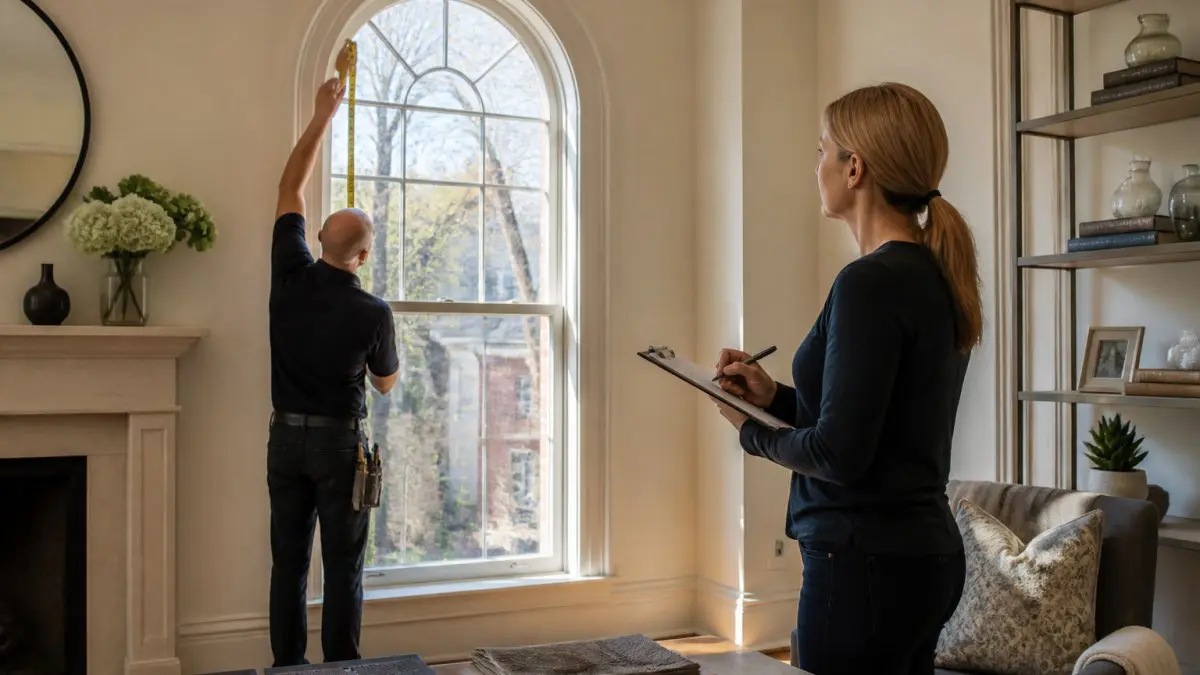
An accurate custom window shade estimate comes from an in-home measurement, not a phone call. Dimensions taken by the homeowner are the single most common source of costly rework, because a half-inch error on an inside mount can mean a shade that will not fit or one that leaks light at the edges. The workflow below is the one most practitioners use to turn a wide price range into one reliable number.
Step 1: Measure Each Window the Right Way
Use a steel tape, not a cloth one, and record every dimension to the nearest eighth of an inch. For an inside mount (shade sits inside the window frame), measure the width at the top, middle, and bottom of the opening and use the narrowest figure; measure the height at the left, center, and right and use the longest. For an outside mount (shade hangs on or above the trim), measure the width and height you want the shade to cover, plus the desired overlap on each side. Note the depth of the reveal, most inside mounts need at least 2 inches of depth for the hardware.
Step 2: Compare Quotes on the Same Line Items
A quote is only comparable if it answers the same questions as the next one. Use this checklist side by side:
- Is the quote itemized into product, labor, and hardware, or is it one lump sum?
- Does it specify the exact fabric, shade type, and lift mechanism by name?
- Are window dimensions listed per opening, matched to the room?
- Is installation included, and is old-treatment removal and disposal included?
- Is there a stated lead time and a warranty term in writing?
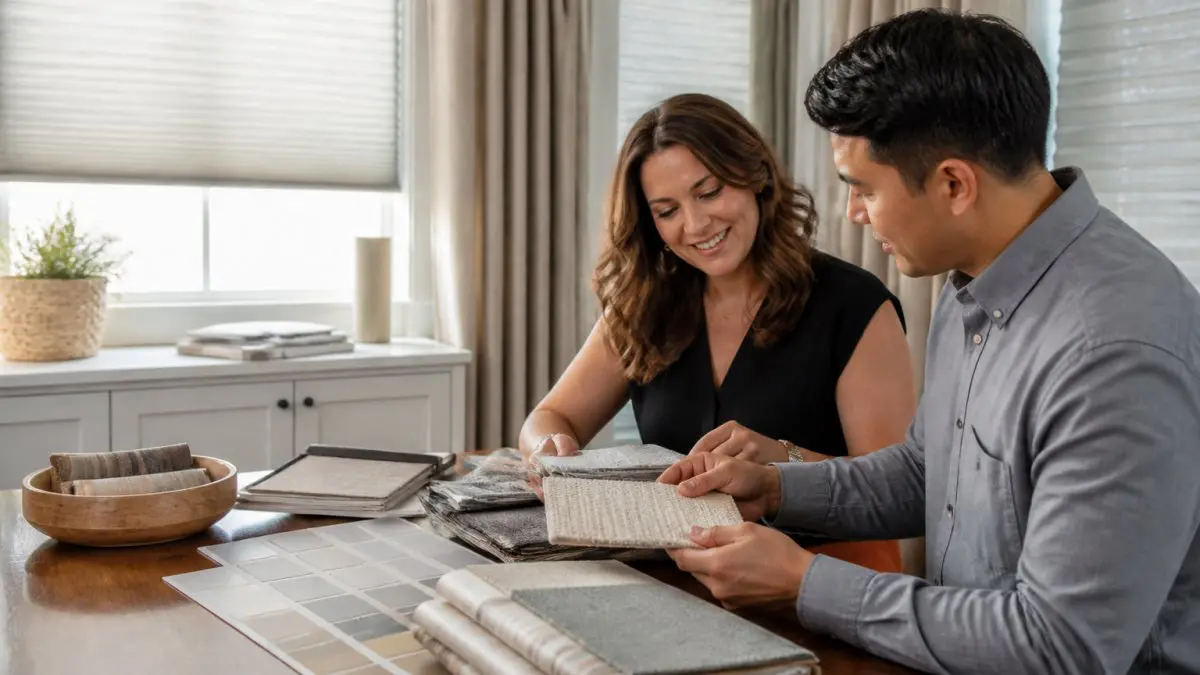
- Are samples provided so you can see the fabric in your own light?
- Does the quote note any template or oversize charges for arched or unusually large windows?
A quote that cannot answer these questions is not comparable to one that can, no matter what the bottom line says. When you are ready for real numbers, contact us to arrange a measurement.
Ask each provider to quote the same shade type and fabric grade for the same windows. Apples-to-apples quotes expose the real differences in labor and hardware instead of hiding them in product upgrades.
Repair, Replace, or Go Custom: Weighing Your Options
Replacement is not always the right call. When existing blinds or shades are merely worn or a mechanism has failed, repair is often the more cost-effective route, a point local service listings make plainly. A restring or a hardware swap costs a fraction of a new order.
The decision comes down to condition and fit. If the existing treatments are the right size and the frames are sound, repair them. If they never fit properly, if the fabric is failing across multiple windows, or if you are upgrading for energy efficiency, replacement with custom shades is the better spend. Going fully custom makes sense when the windows are non-standard or when you want a consistent look across the whole house.
Schedule a Free In-Home Consultation with Carroll Shade
The number on a quote only means something once someone has measured your actual windows. We have served Boston and Brookline homeowners since 1932 as a family-owned business and an authorized Hunter Douglas partner, which means we can match a shade type, fabric, and lift system to the specific openings in your home rather than guessing from a catalog.
Our consultations cover design, measurement, and samples in your own space, so you see how a fabric reads against your walls and your light. We install what we sell and we repair what we install, including motorized systems for the windows you cannot easily reach.
Frequently Asked Questions
What factors affect the cost of custom window shades?
The biggest cost drivers are window size and shape, shade type, fabric or material, and whether you add motorization. Custom window shades pricing also depends on quantity, installation labor, and any specialty features like blackout lining or remote controls. Older homes with arched or non-standard windows often need custom sizing, which adds to the project. Request a quote so each window is priced individually rather than estimated from a generic average.
Do custom window shade prices include professional installation?
Not always. Some quotes bundle materials and labor, while others list them separately. Ask for an itemized custom window shade estimate that separates product cost from window shade installation cost so you can compare bids fairly. Professional installation covers precise mounting, hardware, and calibration for motorized units, which matters in older Boston homes where walls and window frames are not always square.
Are motorized window shades more expensive than manual shades?
Yes. Motorized window shades cost more than manual versions because of the motor, remote, and wiring or battery components. The automated blinds market is forecast to grow at a 7.3% compound annual growth rate from 2026 to 2035, according to Global Market Insights, which reflects rising demand. Motorization pays off most for hard-to-reach second-floor windows, large banks of glass, and homeowners who want scheduled light control.
How can I get an accurate estimate for custom window shades?
Book an in-home or design consultation so windows are measured in person. Bring photos of your rooms and note which windows face south or west, since sun exposure affects fabric choice. Ask for a written, line-item quote that separates materials, labor, and any motorization. Comparing two or three itemized quotes on the same window list is the most reliable way to see what you are actually paying for.

