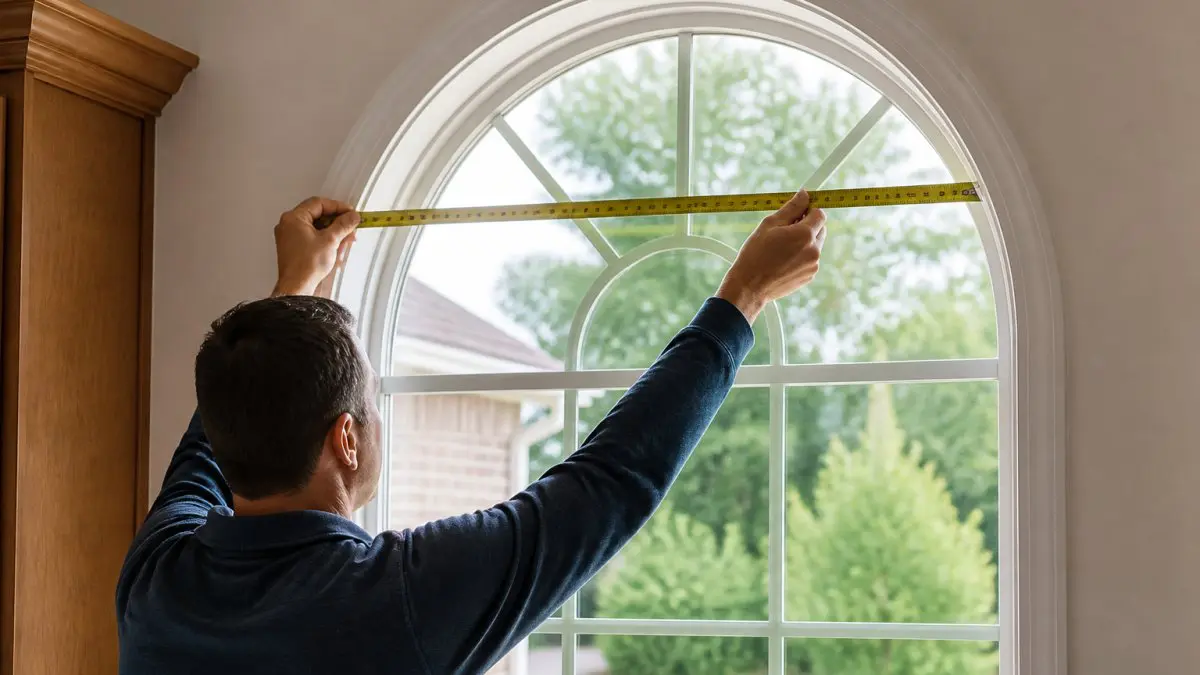
How to Measure Arched Windows for Blinds: Step-by-Step
Table of Contents
- Step 1: Gather the Right Measuring Tools for Custom Blinds
- Step 2: Measure the Arch Base Width and Height at the Center
- Step 3: Identify the Widest Point and Check Window Shape and Symmetry
- Step 4: Measure from Inside the Window Opening and Check Depth
- Step 5: How to Measure a Half-Round Window and Other Arched Shapes
- Step 6: Create an Arched Window Measuring Template for Tricky Shapes
- Step 7: Choosing Blinds for Arched Windows: Inside vs. Outside Mount
- Frequently Asked Questions
Last Updated: October 17, 2026
Step 1: Gather the Right Measuring Tools for Custom Blinds
Measuring arched windows for blinds starts with the right tools, not the right technique. Most homeowners jump straight to the tape and end up with numbers that don’t translate into a proper fit.
Here’s what you actually need:
- Steel tape measure (25-foot is plenty). A cloth tape sags and gives you false readings on a vertical arch.
- A sturdy step stool or ladder. You need to reach the top of the arch safely.
- A notepad and pencil, or your phone’s notes app.
- A small level to check for square corners.
- Painter’s tape for marking reference points.
This guide covers the full process, and we’ll flag the spots where a bad measurement costs you a remake.
Measure in inches and write down fractions, not decimals. Most custom blind manufacturers build to the nearest 1/8 inch, and a decimal conversion invites rounding errors that show up as gaps at the curve.
Step 2: Measure the Arch Base Width and Height at the Center
The base width and center height are the two numbers that define your arch. Get these right and most of the work is done.
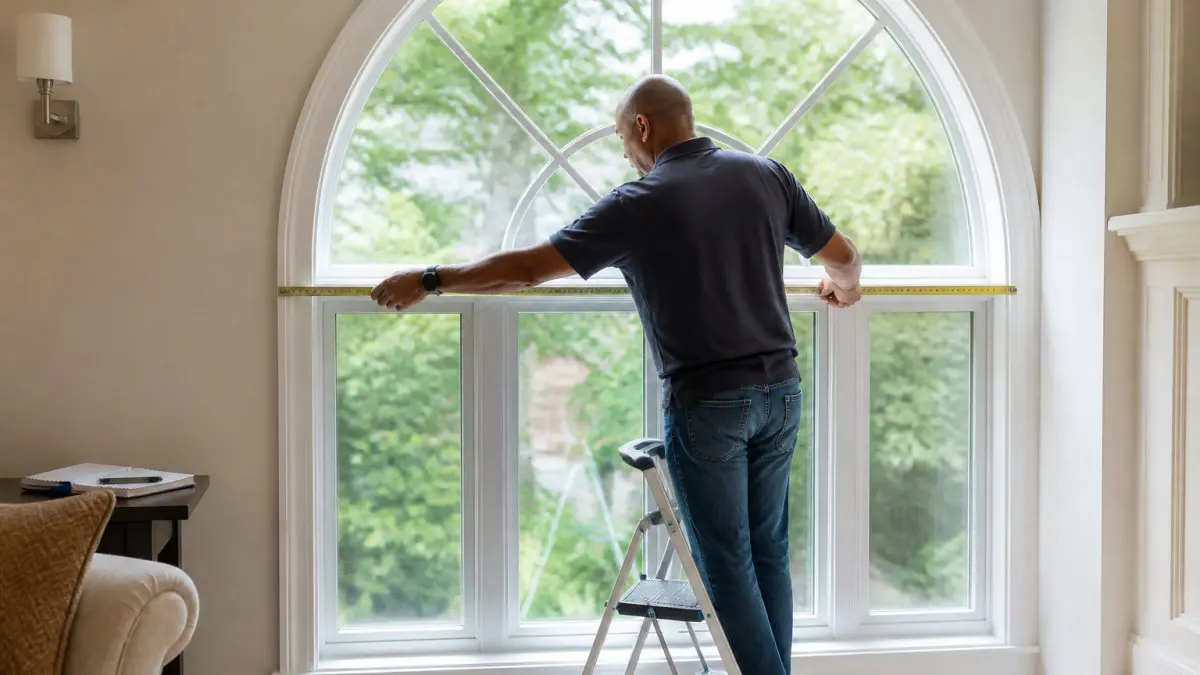
Run your steel tape measure across the bottom of the arch opening, corner to corner. Record that as the base width. Next, find the center point along that base line.
Here’s the part most guides skip: measure the base width in three places (left, center, right) and use the narrowest reading.
Step 3: Identify the Widest Point and Check Window Shape and Symmetry
Not every arch is a perfect semicircle. Before you commit to a measurement, confirm what shape you’re dealing with.
Measure the widest point of the window opening and compare it to your base width. On a true half-round, they match.
Then check symmetry:
- Measure from the center point to the left corner, then to the right corner.
- A difference of more than 1/4 inch means the arch is uneven.
- Check the 90-degree corners at the base with your level.
An uneven arch isn’t a dealbreaker, but it does mean you should tell your fabricator rather than ordering a stock size.
Step 4: Measure from Inside the Window Opening and Check Depth
Inside mount measurements go between the window frame, not across the face of the trim. This is where accuracy really matters.
Take your inside measurement at the base, the center, and near the top of the straight sides. Record all three. For depth, measure from the glass back to the front edge of the frame. You need enough window depth for the blind’s mounting hardware to sit flush without hitting the glass or the crank.
Measuring over old caulk, paint buildup, or a warped frame gives you a false reading. Scrape back any buildup at your measuring points first, or your custom blind will arrive a fraction too wide and won’t seat.
Step 5: How to Measure a Half-Round Window and Other Arched Shapes
Learning how to measure a half-round window is straightforward once you know the shape rule. A true half-round has a base width equal to twice its radius, and its center height equals that radius.
Before you measure any arch, identify the shape. The fastest check is to compare the widest point of the opening to the base width. On a true half-round they are identical and sit on the same line.
Here is how the measuring procedure changes by shape:
- True half-round (semicircular): Measure the base width corner to corner. Measure the center height from the midpoint of the base straight up to the top of the curve. Confirm the height equals half the width within 1/8 inch. If it does, you have a half-round and can order a standard arch blind.
- Segmental arch (shallow curve, less than a half-circle): Measure the base width. Measure the center height. Then measure the rise, the vertical distance from the spring line (the horizontal line where the curve begins) to the top of the arch. Record all three. The fabricator needs the rise to build the correct curvature; base width and center height alone will produce a blind that is too tall at the shoulders.
- Eyebrow arch (very shallow, often asymmetric): Measure the base width at three points (left, center, right) and use the narrowest. Measure the center height. Because the curve is shallow, also measure the height at the quarter points, one-quarter and three-quarters of the way across the base, so the fabricator can see whether the curve is even. An eyebrow arch that is 1/4 inch higher on one side will show a visible gap.
- Gothic or pointed arch: Tape measures cannot describe a pointed arch. You need a template (Step 6). Record the base width, the center height, and the height at the point where the two curves meet. Note whether the point is centered; if it is off-center by more than 1/4 inch, say so on the order.
- Irregular or asymmetric arch: Measure the base width at three points, the center height, and the height at the quarter points on both sides. If any pair of readings differs by more than 1/4 inch, make a template. Do not order from tape measurements alone.
- Round or oval window: Measure the diameter at the widest point in two directions (horizontal and vertical). If the two readings differ, use the smaller one and note the difference. For an oval, also measure the width at the vertical midpoint and the height at the horizontal midpoint.
- Skylight or high arched window: The same shape rules apply, but measure from a stable ladder with a helper holding the tape. Never lean out over a stairwell or reach past your shoulder to read a tape; have the helper read the number and call it back.
Write down the shape name next to your numbers, “half-round,” “segmental,” “eyebrow,” “irregular.” Manufacturers sort orders by shape, and a mislabeled arch is one of the most common reasons a custom blind arrives with the wrong curvature.
One more check that most guides skip: measure the diagonals of the rectangular portion below the arch (from the bottom-left corner to the top-right corner of the straight sides, and the reverse). If the two diagonal readings differ by more than 1/4 inch, the opening is out of square, and an inside-mount blind will bind on one side. Note the difference on your order form so the fabricator can build in a small allowance.
Step 6: Create an Arched Window Measuring Template for Tricky Shapes
An arched window measuring template is the most reliable way to capture a shape that tape alone can’t describe.
What you need: heavy paper or cardstock (a roll of kraft paper works well), a pencil, scissors, and painter’s tape.
- Tape a sheet of heavy paper or cardstock across the window opening, overlapping the frame on all sides by at least 2 inches.
- Press the paper firmly against the frame at the base and along both straight sides so it conforms to the opening.
- Trace the inside edge of the arch with a pencil, following the frame line, not the glass line. Keep the pencil vertical to the paper; tilting it shifts the line by the width of the pencil tip.
- Mark the center point of the base and both base corners with a short tick that extends past the trace line.
- Cut along your trace line and test-fit the template in the opening.
The fit check is where the template earns its keep. Hold the template in place and check three things:
- Rock test: press gently on each corner. If the template rocks, the arch is not symmetric. Note which side sits high.
- Gap test: look for daylight between the template edge and the frame. A gap wider than 1/8 inch means the trace drifted or the frame is uneven.
- Corner test: confirm the base corners sit flush against the frame. If one corner lifts, the opening is out of square.
If the template rocks or leaves gaps, your arch is irregular. Send the template to your fabricator along with your written measurements.
Do not fold the template to fit it in an envelope. A crease becomes a false curve, and the fabricator will build to the crease. Roll it around a cardboard tube or ship it flat.
Measurement tolerances and rounding. Record exact measurements in inches and fractions to the nearest 1/8 inch. Do not round to the nearest 1/4 inch and do not subtract your own deductions, most custom blind manufacturers build to the nearest 1/8 inch and apply their own inside-mount deduction. If you round or deduct on your own, you double the allowance and the blind arrives too small. Write the exact number and let the fabricator handle the deduction.
When measurements differ. If your three base-width readings differ, remeasure before you order.
A template plus exact fractional measurements plus a note about any unevenness is the package that prevents remakes. Tape measurements alone are fine for a true half-round; anything else deserves a template.
Step 7: Choosing Blinds for Arched Windows: Inside vs. Outside Mount
Blinds for arched windows come down to one decision: inside mount or outside mount. Each has a clear best use.
| Mount Type | Best For | Trade-off |
|---|---|---|
| Inside mount | Clean look, deep frames, preserving trim | Needs accurate depth and square frame |
| Outside mount | Shallow frames, irregular arches, hiding gaps | Covers more wall, less flush look |
| Custom arch shade | True half-rounds, specialty shapes | Higher cost, longer lead time |
Inside mount sits within the window opening and looks built-in. It demands a square frame and enough depth for hardware.
What most people miss: the mount choice changes your measurements. Inside mount uses the opening dimensions. Outside mount uses the frame plus the overlap you want on each side. Decide the mount before you measure, not after.
For hard-to-reach arched windows, motorized options remove the need to stretch and lean. At Carroll Shade, we’ve fitted custom Hunter Douglas treatments on arched and specialty windows across the area since 1932, and we handle the measuring and installation.
Frequently Asked Questions
How do you measure an arched window for blinds?
Measure the base width across the bottom of the arch, then measure the height from the center of the base to the tallest point of the arch. Also record the width at the widest point and check for squareness. Measure each arched window separately, even if they look identical. Use a steel tape measure for accuracy and record all measurements in both inches and fractions. These three numbers (base width, center height, and widest width) are what custom blind makers need to build a proper fit.
Should you measure an arched window inside or outside the frame?
Measure inside the window opening for an inside mount, which gives a clean look and preserves the arch shape. For an outside mount, measure the frame’s outer edges and add 2-4 inches on each side for overlap. Inside mounts require accurate depth measurements (at least 2-3 inches of flat surface) and checking for obstructions like crank handles. Outside mounts are more forgiving for irregular arches but block more of the window frame.
How do you measure an arched window that is not a perfect half circle?
For eyebrow, segmented, or irregular arches, you cannot rely on a single center height. Measure the width at the base, then measure the height at the center and at two or three other points along the curve (for example, at 1/4 and 3/4 of the width). Create a paper or cardboard template by tracing the arch from inside the opening. This template, along with multiple height measurements, lets a custom fabricator match the exact curve.
What type of blinds are best for arched windows?
The best blinds for arched windows are custom-made to fit the curve. Options include cellular shades with a curved top rail, Roman shades shaped to the arch, and specialty shutters with a radius frame. Standard rectangular blinds leave gaps at the corners. For half-round windows, a fan-shaped cellular shade or a custom arched shutter provides the best coverage. Motorized options work well for hard-to-reach arched windows. Consult a specialist to match the blind type to your arch shape and mount preference.
Measuring an arched window is unforgiving: one wrong number and the blind won’t fit the curve. If you’d rather not gamble on a custom order, let the team at Carroll Shade handle it. We bring decades of experience with specialty shapes, offer professional installation and repair, and can set you up with motorized options for windows you can’t easily reach. Contact us to schedule a measuring visit and get your arched windows fitted right the first time.
