Durable Hurricane Shutters for Coastal Homes
Last Updated: November 24, 2026
Quick Summary
Durable hurricane shutters for coastal homes are permanent systems such as accordion, Bahama, colonial, or roll-down shutters that stay mounted on the house and close fast, rather than removable panels or plywood. Choose the type you will actually deploy, then anchor it into structural framing to match each opening’s design pressure.
- Permanent shutters cost more up front but deploy in minutes, while panels and plywood demand the most labor during a storm.
- Published costs run $10 to $20 per square foot for storm panels, $15 to $30 for accordion, and $25 to $60 for rolling shutters before installation.
- In salt air, corrosion starts at fasteners, tracks, hinges, and scratched edges, so rinse and inspect hardware each season.
- Shutters must anchor into studs, headers, and sills, not siding or trim, and match the opening’s design pressure.
- Motorized roll-down shutters suit high or hard-to-reach windows so deployment never requires a ladder.
Table of Contents
- Hurricane Shutter Types Built for Coastal Exposure
- Permanent Hurricane Shutters Cost: What Drives the Price
- Storm Shutter Maintenance in Salt Air
- Hurricane Shutter Installation Requirements
- Matching Shutter Style to Coastal Architecture
- Which Hurricane Shutters Are Best for Your Home
- Get a Custom Shutter Assessment for Your Windows
- Frequently Asked Questions
Hurricane Shutter Types Built for Coastal Exposure
Durable hurricane shutters for coastal homes start with one decision: which system matches your exposure, your windows, and how much warning time you actually get.
That distinction matters more than most buying guides admit. A permanent system you can close in minutes protects you in a fast-moving forecast.
Accordion, Bahama, and Colonial Shutters
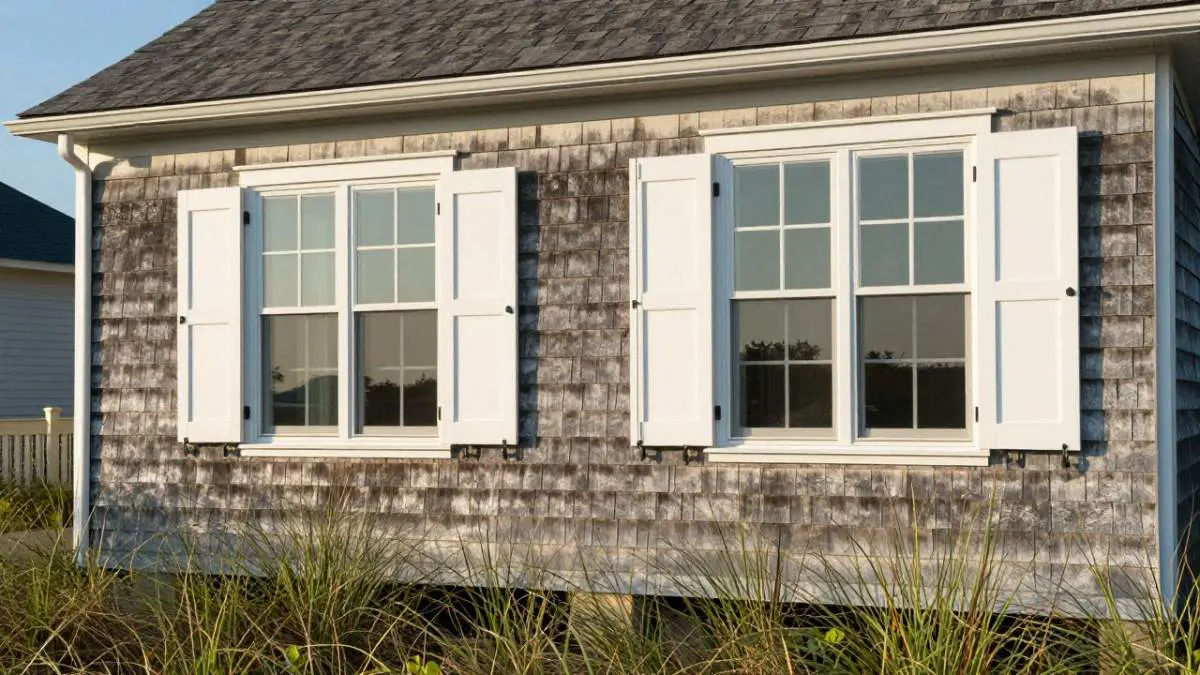
Accordion shutters mount permanently beside each opening and fold out on tracks, so there is no storage and no lifting. Bahama shutters hinge at the top and stay mounted year-round, propped open at an angle to shade the glass. Colonial shutters are the traditional hinged pair, and they suit older New England facades better than any other type.
All three share one advantage: they live on the house. Nothing gets buried behind the snowblower in October.
Roll-Down, Panel, and Plywood Options
Roll-down shutters retract into a housing above the window and close by crank or motor. One manufacturer lists a roll-down system rated to withstand 230 mph winds with an end-retention design that removes the need for storm bars (roll-down shutter wind rating listing).
Storm panels and plywood sit at the other end. They cost least up front and demand the most labor on the day you need them. Plywood works as a stopgap, but it warps, it is heavy, and it offers no tested impact rating.
| Shutter Type | Mounting | Deployment | Best For |
|---|---|---|---|
| Accordion | Permanent, beside opening | Pull closed on track | Fast closing, frequent storms |
| Bahama | Permanent, top-hinged | Prop open or secure | Shade plus protection, coastal style |
| Colonial | Permanent, hinged pair | Swing shut | Antique and traditional facades |
| Roll-down | Permanent, overhead housing | Crank or motor | Hard-to-reach windows |
| Storm panels | Removable | Install before storm | Tight budgets, infrequent use |
| Plywood | Removable | Cut and fasten | Emergency stopgap only |
Permanent Hurricane Shutters Cost: What Drives the Price
Permanent hurricane shutters cost more than removable panels, and the gap is wider than the sticker suggests. Published figures put storm panels at $10 to $20 per square foot, accordion shutters at $15 to $30, and rolling shutters at $25 to $60, all before installation (hurricane shutter cost comparison by type).
Four things move the number: the number and size of openings, the operating mechanism, whether you choose manual or motorized operation, and how much retrofit work the framing needs. A second-floor window that requires scaffolding changes the labor line entirely.
Storm Shutter Maintenance in Salt Air
Storm shutter maintenance in salt air comes down to one enemy: corrosion, and it attacks in a predictable order. Salt film lands on the panel face, but the damage starts at fasteners, tracks, hinges, and every cut or scratched edge where the protective finish is thinnest. A shutter that looks fine from the street can have corroding anchors behind it, which is why the maintenance schedule has to reach the hardware, not just the paint.
How each material behaves in marine air
| Material | Corrosion behavior | What to do |
|---|---|---|
| Aluminum (mill or painted) | Resists rust but pits in salt; painted edges and cut ends are vulnerable | Keep the finish intact; touch up scratches and cut edges before storm season |
| Stainless steel hardware (316 grade) | The marine standard; 304 grade stains in salt air | Specify 316 where hardware is exposed; rinse tracks and hinges each season |
| Galvanized or zinc-plated fasteners | Coating wears at threads and heads first | Inspect annually and replace rather than repaint |
| Composite and engineered polymer | Resists salt but can chalk and fade under strong sun | Clean with fresh water; avoid abrasive pads that dull the surface |
| Wood (Bahama and Colonial) | Absorbs moisture, checks, and grows mildew | Keep paint or stain intact; inspect joints and end grain |
A common pattern in coastal work is mixed hardware: aluminum panels on stainless tracks with galvanized bolts. The bolts are the weak link, and they are also the cheapest part to upgrade.
A season-by-season routine
- Before storm season: rinse tracks, hinges, and anchors with fresh water; inspect every fastener for corrosion and replace rather than repaint; lubricate the operating mechanism with a coastal-rated product; touch up any scratched finish; and test the full deployment path while the weather is calm.
- After any salt event or storm: rinse again, because wind-driven salt reaches surfaces that rain alone does not clear.
- Annually: check anchor embedment and the wall around each fastener for staining or softness, which can signal corrosion behind the surface.
Watch out: skipping the pre-season test is the mistake we see most. A shutter that jams in fair weather will jam under load, and that is not a discovery to make at hour six of a storm warning.
Lifecycle cost by shutter type
The purchase price is only the first line. Over a coastal service life, the maintenance and replacement profile differs by type:
- Accordion and roll-down: highest up-front cost, but the mechanism is the maintenance item, tracks, rollers, and cranks. Budget for periodic hardware replacement rather than panel replacement.
- Bahama and Colonial: moderate up-front cost, with ongoing paint and hinge upkeep. Wood versions need the most attention; aluminum and composite versions less.
- Storm panels: lowest up-front cost, but the fasteners and panel edges take handling damage every time they are installed, and the labor is yours each storm.
The maintenance line is smaller than the replacement line, which is why the routine above is worth keeping.
Hurricane Shutter Installation Requirements
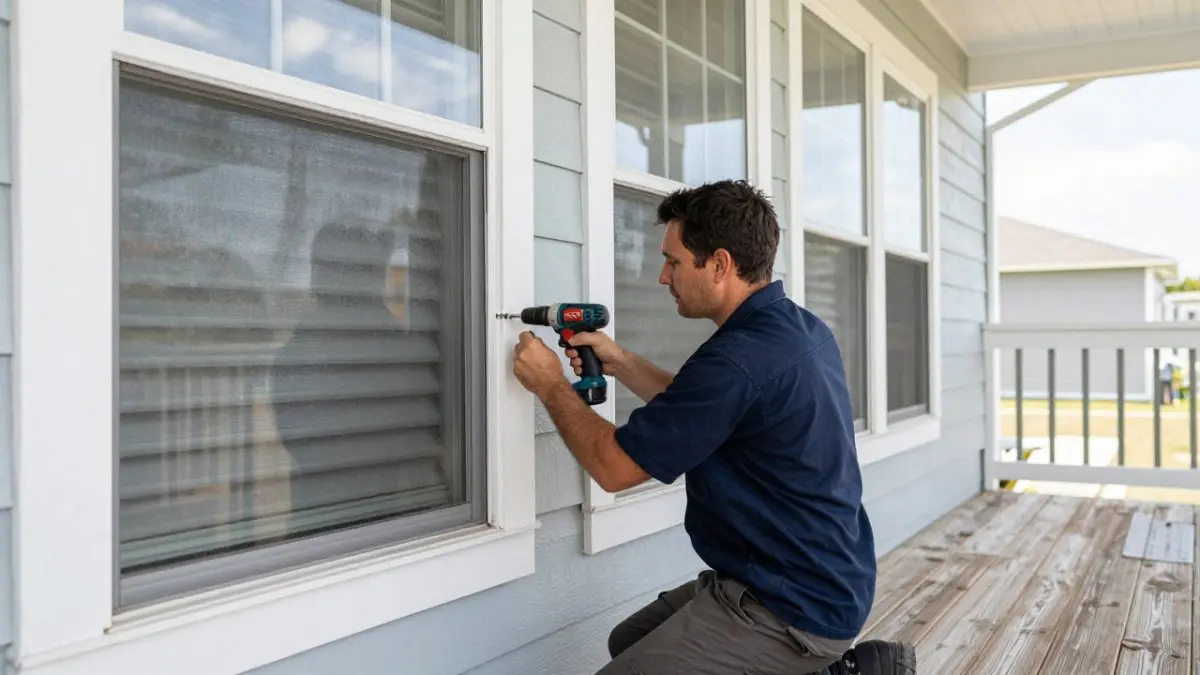
Correct installation is what turns a rated product into real protection. Shutters must anchor into structural framing, studs, headers, and sills, not into siding, trim, or sheathing alone. The fastener schedule has to match the design pressure for the opening, and that pressure is set by the building code your jurisdiction enforces.
What the code actually requires
In high-wind zones, the governing document is the International Residential Code (IRC) and its companion International Building Code (IBC), which reference ASCE 7 for wind-load calculation. Coastal jurisdictions adopt these with local amendments, and the amendments are where the real requirements live. Two things to verify before you buy anything:
- The design pressure for each opening. This is expressed in pounds per square foot (psf) and depends on wind speed, exposure category, height, and the size of the opening. A large picture window on an upper floor can carry a much higher psf than a small bedroom window at grade.
- The product approval. Most coastal jurisdictions maintain an approved-product list, and a shutter must appear on it with a rating equal to or greater than the opening’s design pressure. Ask for the approval number and the evaluation report, not just a brochure claim.
Impact ratings are separate from wind ratings. A shutter can hold against pressure and still fail the missile test. The commonly cited benchmarks are large-missile impact (a 9-pound 2×4 traveling at 34 mph, per ASTM E1886/E1996 testing protocols) and small-missile impact for higher-velocity zones. A product that passes wind pressure but not missile impact is not equivalent protection, and the approval listing will say which test it passed.
Attachment methods and what they change
| Wall assembly | Typical anchor approach | What to watch |
|---|---|---|
| Wood frame with sheathing | Lag screws or structural screws into studs, sized to the approval | Stud location must be verified, not assumed |
| Masonry or brick veneer | Sleeve anchors or epoxy-set anchors into the backup wall | Veneer alone is not structure; anchors must reach the framing or CMU behind it |
| Stucco over frame | Anchors must penetrate to studs through the stucco | Stucco thickness varies and can hide shallow framing |
| Concrete or CMU | Wedge anchors or cast-in inserts | Edge distance and embedment govern capacity |
A permanent track system, accordion or roll-down, concentrates load at a small number of anchor points, so those points carry more responsibility than a panel system spread across many fasteners. That is why track systems usually require a site-specific approval or an engineer’s letter when the wall assembly is unusual.
Retrofit constraints that decide the outcome
Older homes present three recurring problems. First, irregular openings: a window that is out of square by half an inch can prevent a panel from seating, and the fix is a custom panel, not a bigger hammer. Second, shallow jambs: a roll-down housing needs headroom above the opening, and a low header may force a surface-mounted box that changes the elevation. Third, non-standard framing: 2×4 studs at 24 inches on center carry less anchor capacity than 2×6 at 16 inches, and the approval listing assumes a specific substrate.
Watch out: an installer who quotes per window over the phone has not seen your framing, and the anchor schedule is the part of the job most likely to be undersized.
If you want the fitting handled as part of a broader window upgrade, our team handles window installation and repair services alongside shutter work, so the openings and the protection are assessed together.
Matching Shutter Style to Coastal Architecture
Shutter style is an architectural decision as much as a protective one, and the wrong choice is visible from the street every day. Bahama shutters belong on stucco and cottage-style facades where the angled louver reads as shade.
Aesthetic appeal is not vanity here. Exterior shutters change the whole elevation of a house, and buyers notice. The right style adds coastal character; the wrong one looks bolted on.
Which Hurricane Shutters Are Best for Your Home
The best hurricane shutters for your home are the ones you will actually close. That single test eliminates more options than any spec sheet.
Work through it in order:
- If someone is home through storm season and warnings come fast: accordion or roll-down, permanently mounted.
- If the windows are high, arched, or hard to reach: motorized roll-down, so deployment does not require a ladder.
- If the house is antique with distinctive trim: Colonial shutters sized to the opening, or a low-profile roll-down.
One contrarian point worth raising: shutters are not automatically necessary on every oceanfront home.
Beyond storm protection, shutters add security, privacy, and sun control, which is why the decision deserves more thought than a per-square-foot comparison.
Get a Custom Shutter Assessment for Your Windows
As an authorized Hunter Douglas partner and a family-owned business, we offer professional installation and blind repair services, including motorized window treatment options.
Ready to stop guessing which system fits your house? Contact us to arrange an assessment of your windows and openings.
Coastal protection rewards planning over panic. If your shutters were sized for a catalog instead of your walls, the gap will show up in the worst weather.
Frequently Asked Questions
Which hurricane shutters are best for coastal homes?
There is no single best option, because the right hurricane shutters depend on your window layout, budget, and how quickly you need to deploy protection. Accordion and roll-down shutters stay mounted year-round and deploy fast, while storm panels cost less per square foot but require storage and manual setup. Rolling shutters typically cost more than other permanent options but offer push-button operation. Coastal homeowners should weigh deployment time and salt-air durability alongside upfront price.
How much do permanent hurricane shutters cost?
Permanent hurricane shutters cost more upfront than removable panels but save time during storm season. Permanent shutters generally cost more upfront than removable panels. Installation, window count, and motorization add to the total. For an accurate figure on your home, request a measured quote rather than relying on per-square-foot averages.
Are accordion or roll-down shutters more durable?
Both accordion and roll-down shutters are permanently mounted systems that avoid the wear of repeated installation and removal. Roll-down shutters are often specified with explicit wind ratings; Accordion shutters fold compactly beside the opening and are described as efficient and affordable. Durability in salt air depends heavily on aluminum grade, finish quality, and hardware, so ask about corrosion-resistant coatings for either type.
How do I maintain hurricane shutters in a salt-air environment?
Rinse aluminum shutters and hardware with fresh water several times during storm season to remove salt deposits, and inspect hinges, tracks, and locking mechanisms for corrosion. Lubricate moving parts with a marine-grade product, and touch up any scratches in the finish before they spread. Routine freshwater rinsing helps protect hurricane shutters from salt-related corrosion.
Can you leave hurricane shutters up all year?
Permanent systems such as accordion, Bahama, and roll-down shutters are designed to stay mounted year-round, though most homeowners keep them open or retracted outside storm season. Bahama shutters in particular are designed to be propped open at an angle, providing shade and privacy when not deployed for protection. Removable storm panels and plywood are not meant to stay up, since they block light and ventilation. Check your local building code and homeowner insurance terms before leaving any system permanently deployed.

