Modern Window Treatments for Boston Apartments
Last Updated: November 15, 2026
Quick Summary
Modern window treatments for Boston apartments must handle radiators under windows, deep plaster walls, and close neighbors, so check your lease and window exposure before buying. Choose by exposure and floor first: solar shades for west glare, cellular shades for cold windows, and full privacy coverage on first-floor street-facing units.
- Read your lease and get written permission before drilling into window frames or adding exterior hardware.
- Tension-fit shades and spring-loaded rods install without screws, suiting rental apartments.
- Solar shades filter glare and keep the view but are not blackout, so neighbors can see in at night.
- Cellular shades trap air to slow heat loss on cold, drafty windows.
- Measure the full frame width for sliding doors so the headrail clears the door’s top trim.
Table of Contents
- Why Boston Apartments Need Different Window Treatments
- Modern Window Treatments Compared: Shades, Blinds, and Drapery
- Choosing Blinds for Apartment Windows Without Losing the View
- Apartment Blinds for Sliding Glass Doors: What Actually Works
- Apartment Blinds Replacement: Repair Before You Replace
- What Modern Window Treatments for Boston Apartments Price Out To
- Book a Free In-Home Measure Before You Order
- Frequently Asked Questions
Why Boston Apartments Need Different Window Treatments
Modern window treatments for Boston apartments solve problems that suburban homes rarely face: radiators under every window, deep plaster walls that resist drilling, and neighbors close enough to see straight into your kitchen. At Carroll Shade, we’ve served the Boston area since 1932, and the same issues come up in many apartments.
The biggest mistake we see is buying online before checking two things: what your lease allows and which direction your windows face. Get either wrong and you’ve spent money on treatments that fight your building or your light.
Rental Rules and Drilling-Free Installation
Read your lease before you buy anything. Leases can restrict drilling into window frames, and some buildings add their own rules about exterior hardware. If you rent, ask the building manager what’s permitted in writing.
Drilling-free options exist. Tension-fit shades sit inside the window frame with no screws. Spring-loaded rods hold drapery panels without brackets. A common mistake is assuming a landlord will approve a bracket because it’s “small,” so get the yes first.
Heat, Glare, and Privacy by Window Exposure
Window orientation decides which treatment actually works. South-facing windows take the hardest sun and the most heat gain, so they need a shade that blocks light without turning the room into a cave. West-facing windows catch harsh afternoon glare, which makes solar shades the practical pick. North-facing windows give steady, soft light, so privacy matters more than heat control there.
Floor level changes the calculation too. A first-floor unit facing the street needs full privacy coverage. A tenth-floor unit with a view should keep it. We recommend choosing by exposure and floor before you choose a color or style.
Modern Window Treatments Compared: Shades, Blinds, and Drapery
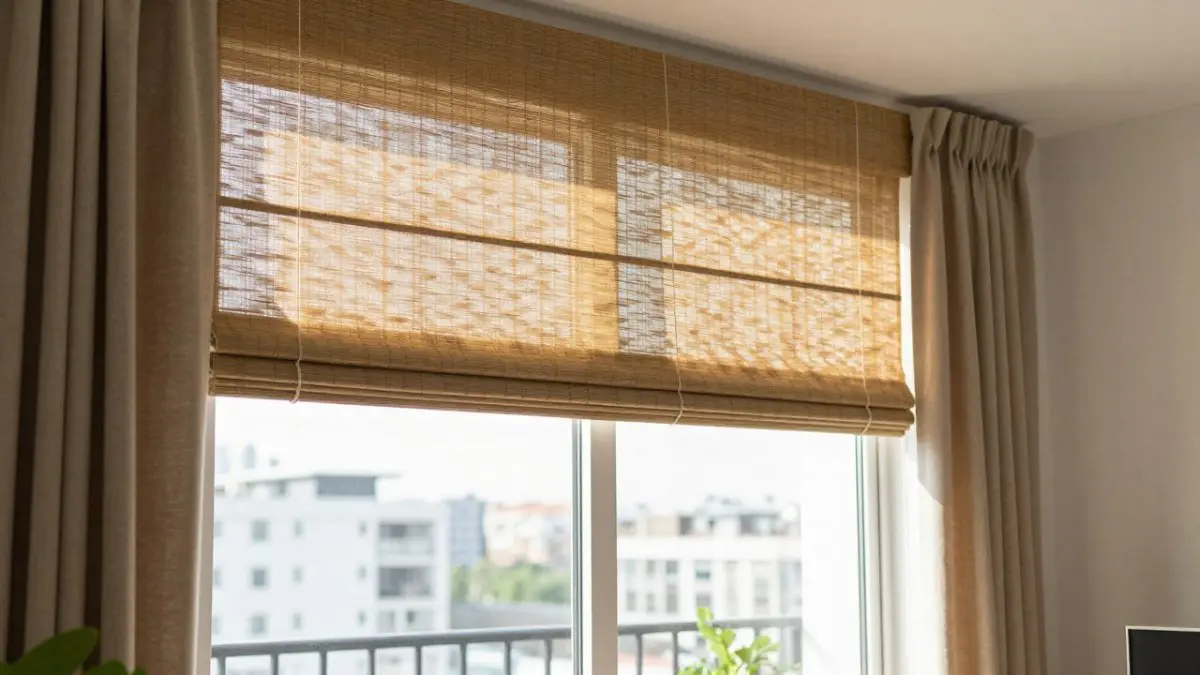
Modern window treatments break into three families: shades, blinds, and drapery. Shades are fabric panels that roll, fold, or stack. Blinds are slatted and tilt to control light. Drapery is fabric hung on a rod. Each suits a different apartment problem.
Here’s how the main styles compare for apartment living:
| Style | Light Control | Insulation | Best For | Watch Out For |
|---|---|---|---|---|
| Roller shades | Good | Low | Clean modern look | Little heat blocking |
| Solar shades | Filters glare | Low | Preserving the view | Not full privacy at night |
| Cellular shades | Good | High | Cold windows, street noise | Higher cost per window |
| Roman shades | Good | Medium | Decorative rooms | Fabric gathers dust |
| Wood or faux-wood blinds | Adjustable | Low | Classic interiors | Slats bend easily |
| Drapery panels | Soft | Medium | Layering, softening edges | Takes wall space |
Roller and Solar Shades for Light Filtering and Glare Reduction
Roller shades are the cleanest option for a modern apartment. A single fabric panel rolls flat into a slim cassette, so the window keeps a sleek line. Solar shades do the same job with a woven screen that filters glare and blocks UV while keeping some view-through.
Solar shades are not blackout. At night, with a light on inside, neighbors can see in. Pair a solar shade with drapery if you want daytime glare control and evening privacy.
Cellular Shades for Insulation and Roman Shades for Style
Cellular shades, also called honeycomb shades, trap air in their pockets, which slows heat loss through the glass. They’re a practical pick for a cold, drafty window.
Roman shades fold into soft horizontal stacks when raised. They bring color and pattern into a room in a way roller shades can’t. For a living room where the window is part of the design, Roman shades earn their place.
Choosing Blinds for Apartment Windows Without Losing the View
Blinds for apartment windows give you the finest control over light. Tilting the slats lets you cut glare while keeping sightlines to the street or skyline. That adjustability is why blinds stay popular in condos and urban apartments.
Faux-wood blinds are an option for humid conditions and can be a lower-cost alternative to real wood. For a window you open daily, a cordless lift keeps the look clean and removes a hanging cord from a small room.
Blinds gather at the top when raised, so measure how much window you’ll lose.
Apartment Blinds for Sliding Glass Doors: What Actually Works
Apartment blinds for sliding glass doors fail when the treatment blocks the door’s travel. A standard blind mounted outside the frame catches on the handle or stops the panel from sliding.
Vertical blinds are the traditional answer, and they still work: the vanes tilt and stack to one side. Panel track systems are another option, where wide fabric panels glide on a track and stack clear of the opening. For a patio door that gets heavy sun, a roller shade mounted above the frame keeps the track clear and rolls up out of the way.
Measure the full frame width, not just the glass, and check that the headrail clears the door’s top trim.
Apartment Blinds Replacement: Repair Before You Replace
Apartment blinds replacement is often unnecessary. Many broken blinds need a new cord, a replaced tilt mechanism, or a restrung ladder, not a whole new set. Carroll Shade provides blind repair services alongside installation.
Signs a repair makes sense:
- The blind won’t raise or lower evenly
- A cord has snapped or frayed
- Slats are intact but the tilt wand spins freely
- The headrail is sound but the lift mechanism jams
Replace instead when slats are cracked, the headrail is bent, or the hardware is discontinued. If you’re weighing repair against a full upgrade, our experts in window installation and repair services can tell you which path fits your window.
What Modern Window Treatments for Boston Apartments Price Out To
Pricing for apartment window treatments depends on quantity, dates, delivery, and the specific product and window. For current prices or a quote, visit the Carroll Shade website or contact us for a written quote per window before you commit.
Typical Price Tiers by Product Type
These are the ranges most practitioners in this market quote for a single standard apartment window, product only, before installation and tax:
| Product | Typical Product Range (per window) | What Drives the Price |
|---|---|---|
| Stock roller shade | $30-$90 | Fabric grade, cassette vs. open roll |
| Custom roller or solar shade | $90-$300 | Fabric openness factor, cassette, size |
| Cellular (honeycomb) shade | $80-$350 | Cell size, single vs. double cell, cordless lift |
| Roman shade | $150-$500 | Fabric, lining, lift system, custom width |
| Faux-wood blinds | $40-$150 | Slat width, cordless tilt, headrail quality |
| Real wood blinds | $100-$300 | Wood species, slat width, finish |
| Drapery panels (pair) | $200-$800 | Fabric, lining, fullness, hardware |
| Panel track for a slider | $300-$900 | Panel count, fabric, track length |
| Motorized upgrade | Add $150-$500 per window | Motor type, hub compatibility, wiring |
Treat these as planning ranges, not quotes. A 72-inch-wide window costs more than a 36-inch one in the same fabric, and a deep plaster frame that needs a custom cassette pushes toward the top of the range.
The Cost Drivers That Actually Move the Number
Four variables explain most of the variance between two quotes for what looks like the same job:
- Custom versus stock sizing. Stock sizes are cheaper but rarely fit older apartment openings cleanly. Uneven frames, deep reveals, and arched windows usually force made-to-measure, which adds cost but eliminates light gaps and returns.
- Width and height. Fabric is priced by the square foot in most lines, so a wide living-room window can cost two to three times a narrow bedroom window in the same style.
- Lift and control type. Cordless and motorized lifts add cost over a standard cord loop. Motorization is worth it on high or hard-to-reach windows; it is hard to justify on a window you open by hand every day.
- Installation method. Inside-mount tension-fit shades avoid drilling and usually install faster than bracket-mounted hardware, which can lower labor on a rental. Outside-mount drapery with a long rod and multiple brackets takes longer.
Installation and Total Installed Cost
Product price is not the whole number. Installation costs depend on mount type, access, and the product chosen. For a quote that covers your windows, contact Carroll Shade.
Measuring errors can add cost, so measure carefully before ordering.
How to Compare Quotes
Ask for a written quote that breaks out product, hardware, installation, and tax per window. Confirm whether the quote includes the cassette or valance, the lift type, and removal of old hardware.
Typical product price ranges per apartment window
Book a Free In-Home Measure Before You Order
Measuring carefully before you order helps avoid a fit problem on a deep frame. Contact Carroll Shade to ask about an in-home measure.
We also offer motorized options for high or hard-to-reach windows.
Ready to start? Contact us to book your measure and talk through options for your windows.
Boston apartments ask more of a window treatment than most homes do: they have to respect a lease, handle a radiator, keep a view, and survive a real winter. Carroll Shade has fitted shades, blinds, drapery, and motorized treatments in this city since 1932, as an authorized Hunter Douglas partner. We measure, install, and repair, so one team handles the whole job. Get started with Carroll Shade and get window treatments that fit your apartment the first time.
Frequently Asked Questions
What are the best window coverings for apartments?
The best choice depends on the window and the lease. Roller and solar shades suit large living room windows because they filter light and cut glare while keeping some view. Cellular shades add insulation on drafty walls. For rentals, cordless and tension-fit options avoid drilling. Measure the inside of the frame first, confirm any building rules on hardware, and pick a treatment that matches the window’s exposure before you order.
What are the best blinds for apartment windows?
Slim-profile blinds work well in apartments because they fit shallow frames and leave the sill clear. Horizontal blinds give adjustable light control for bedrooms, while vertical blinds handle wide openings. Look for cordless operation if you have pets or children, and check whether your lease allows bracket screws. If drilling is off the table, tension or adhesive-mounted options cover most standard apartment windows without permanent marks.
Can apartment blinds be replaced without damaging the windows?
Yes, in most cases. Existing brackets usually come out with a screwdriver, and the small holes can be filled before you move out. If you are starting fresh and the lease forbids drilling, tension-fit and adhesive-mounted shades hold on standard frames without hardware. Confirm the rule with your landlord in writing, keep the original hardware, and reinstall it before your final walkthrough so the window is returned to its original condition.
Which window treatments provide privacy without blocking natural light?
Top-down/bottom-up shades are the clearest answer. They open from the top so daylight enters above eye level while the lower half stays covered. Solar shades with a more open weave also keep daytime privacy from the street while preserving the view outward. Sheer drapery panels layered over a roller shade give you a soft daytime filter and full coverage at night. Match the openness level to how close neighboring buildings are.
What window treatments work best for sliding glass doors?
Vertical blinds, panel track systems, and wide roller shades are the practical picks for sliding glass doors. They stack to one side so the door still slides freely, and they handle the wide span better than standard horizontal blinds. Choose a cordless or motorized operating option if the door is a main traffic path, and mount the track to the header rather than the glass so the door is not carrying the weight.

