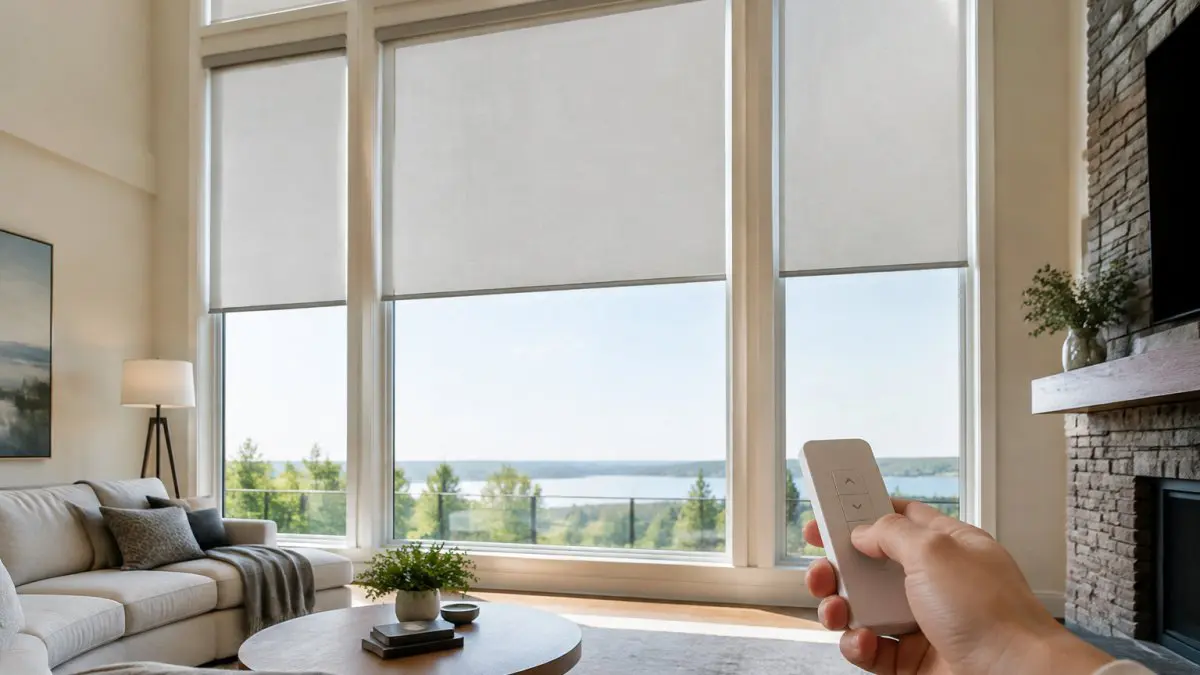
Motorized Blinds for High Windows: What They Really Cost
Last Updated: November 4, 2026
Quick Summary
Motorized blinds cost about $500 per window on average, with most projects landing between $400 and $2,500, according to Angi’s 2026 analysis. High windows sit at the top of that range because access equipment and extra labor push the installed price higher.
- Labor for motorized window treatments generally runs $50 to $200 per window, depending on complexity and height.
- Motorized roller shades typically run $400 to $900 or more per window, while Roman shades start around $600 and climb past $1,500.
- Access equipment is the line item most likely to be omitted from a phone quote and added at the site visit.
- Battery motors cost less upfront than hardwired motors because no electrician is involved.
- Properly managed window coverings can cut heat gain by up to 77% and heat loss by up to 31%.
Table of Contents
- Why High Windows Change the Motorized Blinds Cost
- Per-Window Price Ranges by Shade Style and Window Size
- The Cost of Motorized Blinds Installed: Labor and Access Charges
- Motorized Blinds Battery vs Hardwired Cost Over Time
- Smart Blinds Pros and Cons for Hard-to-Reach Windows
- Three Installed Budgets by Window Height and Quantity
- Measuring, Quoting, and Choosing a Motorized Solution
- Frequently Asked Questions
Why High Windows Change the Motorized Blinds Cost
Motorized blinds for high windows cost more than standard-height installations, and the gap is bigger than most homeowners expect. The national average to install motorized blinds runs about $500 per window, according to Angi’s 2026 motorized blinds cost analysis, with most projects landing between $400 and $2,500. High windows sit at the top of that range for a simple reason: everything gets harder when the sill is eight feet off the floor.
Height drives access, access drives labor, and labor drives the final number.
The Three Cost Drivers: Height, Access, and Power
Three variables move the price more than anything else: how high the window sits, how hard it is to reach safely, and how the motor gets power. A motorized roller shade at eye level and the same shade above a staircase are different jobs. The hardware may be identical. The installation is not.
Height also changes your power options. A window above a stairwell is a poor candidate for a hardwired motor, so battery or solar becomes the practical choice. That decision affects both the upfront cost and what you pay over the life of the treatment.
Per-Window Price Ranges by Shade Style and Window Size
Shade style sets the baseline price before height enters the picture. Motorized roller shades typically run $400 to $900 or more per window, while motorized Roman shades start around $600 and climb past $1,500, according to Bloomin’ Blinds’ 2026 motorized blinds pricing guide. Cellular shades fall between those two.
Window size compounds it. Wider and taller openings generally need bigger motors, heavier tubes, and more fabric, so larger shades usually cost more. Ask Carroll Shade how custom sizing applies to your openings.
| Shade Style | Typical Per-Window Range | Best For |
|---|---|---|
| Roller shades | $400-$900+ | Clean lines, easy motorization |
| Cellular shades | $450-$1,100+ | Energy efficiency, soft light |
| Wood or faux wood blinds | $350-$800+ | Traditional interiors |
| Roman shades | $600-$1,500+ | Fabric-forward rooms |
Fabric choice matters too. Fabric choice can affect the configured price, and a valance can add to it.
The Cost of Motorized Blinds Installed: Labor and Access Charges
The cost of motorized blinds installed splits into two buckets: product and labor. Labor for motorized window treatments generally runs $50 to $200 per window, according to Angi’s installation cost breakdown, depending on complexity and window height. That range is useful as a baseline, but it hides the line items that separate a standard-height job from a high-window project. Here is how the installed cost actually breaks down when the sill is well above reach.
Itemized Cost Breakdown for High Windows
A high-window quote typically contains five cost components. Asking for each one separately is the fastest way to compare bids that otherwise look identical on the bottom line.
- Shade or blind product. The configured price of the treatment itself, including custom sizing, fabric, and any valance or cassette. This is the same line item you would see on a standard-height window of the same size.
- Motor and control. The motorized headrail, remote, and any hub or bridge. Battery motors usually cost less upfront than hardwired motors because no electrician is involved.
- Access equipment. Ladders, scaffolding, or a lift rental, plus the labor time to set up and move it. This is the line item most likely to be omitted from a phone quote and added at the site visit.
- Wiring or power access. For hardwired motors, an electrician runs power to each window location. For battery systems, this line is usually zero, but solar charging panels may appear here instead.
- Installation labor. Measured in installer-hours, not just per window. Two installers on a 16-foot window may spend more time setting up access than actually mounting the brackets.
Access equipment and the extra labor to use it are often the lines that push a high-window project above the average per-window cost.
What Professional Installation Adds Per Window
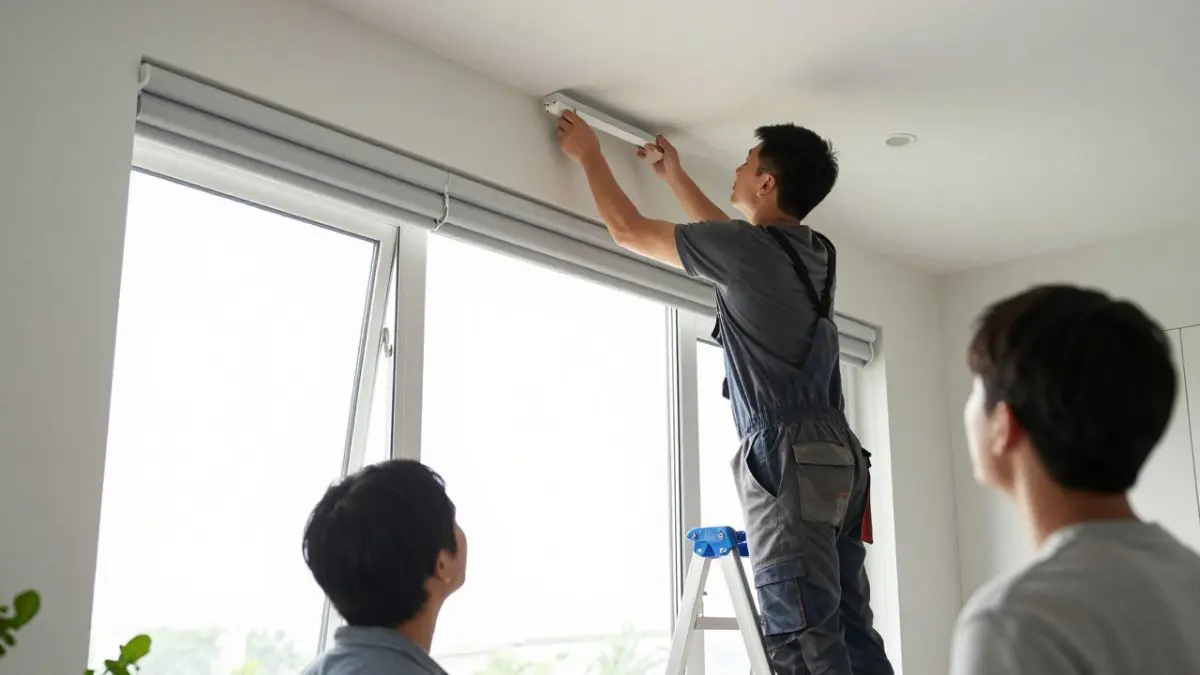
Access is where high windows separate from the pack. A window over a stairwell, a two-story foyer, or a sunroom with a steep roofline may need scaffolding, a taller ladder, or two installers instead of one. That pushes labor toward the top of the range and sometimes beyond it.
Professional installation covers precise measuring, bracket placement, and motor pairing with remotes or a smart-home hub. Learn more about Carroll Shade’s services.
When comparing quotes, ask the installer to state in writing what access equipment the job requires and whether that cost is included.
Motorized Blinds Battery vs Hardwired Cost Over Time
Battery-powered motors cost less upfront and far more over the years. A rechargeable battery system avoids an electrician entirely, which keeps the installed price down. The tradeoff arrives later in battery replacement and the labor to reach high headrails when they die.
Hardwired motors need an electrician to run power to each window, which adds a line item most quotes do not show until the site visit. In exchange, you stop thinking about charging. For a whole-home project, hardwired often wins on long-term ownership cost. For two or three high windows in an older home, battery plus a solar panel is usually the smarter spend.
Smart Blinds Pros and Cons for Hard-to-Reach Windows
Smart blinds solve the core problem of high windows: nobody wants to climb a ladder twice a day. Remote control, scheduling, and smart-home compatibility mean a foyer window can open at sunrise without anyone touching it.
The cons are real. Upfront cost is higher than manual treatments, and motorized systems carry maintenance requirements that manual blinds do not. Motors, remotes, and hubs can fail, and repairs on a 16-foot window are not a weekend project.
The reliability question homeowners ask us most is fair. Modern motors are dependable, but they are electronics, and electronics eventually need service. Buy from a company that will come back and fix them, not one that disappears after the sale.
Three Installed Budgets by Window Height and Quantity
Here is where the numbers become concrete. These three scenarios show how height and quantity reshape a realistic installed budget, using the per-window ranges above plus labor. Each scenario states its assumptions so you can adjust the numbers to your own project rather than treating them as fixed quotes.
Scenario 1: Two standard-height windows, 6 feet.
Assumptions: motorized roller shades in a standard fabric, battery motors, one installer, no special access equipment, existing mounting substrate in good condition. Product at $400-$700 each plus $50-$100 labor per window puts the project near $900-$1,600 installed. This is the baseline against which the high-window scenarios should be measured.
Scenario 2: Three high windows over a staircase, 12 feet.
Assumptions: custom-sized roller or cellular shades, battery motors with solar charging panels, two installers, a tall ladder or small scaffold, and a stairwell that requires careful setup. Product and motor costs rise with the larger custom sizes; access equipment and the second installer add labor hours. A realistic installed range is roughly $2,500-$4,500, with the access and labor lines accounting for a meaningful share of the difference from Scenario 1.
Scenario 3: Five windows in a two-story foyer, 16 feet.
Assumptions: premium fabrics, battery motors with solar panels or a hardwired option with an electrician, scaffolding rental, extended lead times for custom sizing, and two installers across a full day. Scaffolding, extended lead times, and premium fabrics land this project in the $5,000-$9,000 range. If the homeowner chooses hardwiring instead of battery, add the electrician’s line item, which is quoted separately and varies with how far power must be run.
When comparing quotes, confirm whether access equipment, a second installer, and any electrician work are included in the quoted number.
Measuring, Quoting, and Choosing a Motorized Solution
Accurate measuring is the difference between a shade that seals and one that leaks light around the edges. High and awkward windows are the hardest to measure from a ladder, and a wrong number means a custom shade that cannot be returned.
Accurate measuring matters for tall or arched openings. When you are ready to talk through options, contact us for a quote.
One more consideration: energy. Properly managed window coverings can cut heat gain by up to 77% and heat loss by up to 31%, according to Blindsgalore’s window treatment research. On a wall of high south-facing glass, that is a meaningful offset against the upfront cost.
Frequently Asked Questions
How much do motorized blinds cost per window?
Pricing depends on window size, shade style, access, and power type. For current pricing on your windows, contact Carroll Shade for a quote.
Can I install motorized blinds on high windows myself?
You can, but the risk climbs with height. The hardware is heavier than a manual shade, and mounting brackets must be level or the motor strains. Most homeowners hire a professional for second-story or high-ceiling windows. Professional installation can help avoid the cost of a redo after a bad measurement or a dropped motor.
What are the best power options for hard-to-reach motorized blinds?
Rechargeable battery motors are the simplest choice for tall windows because no wiring is needed, though you will need a safe way to reach the shade for periodic charging. Hardwired power can remove the need for battery swaps, which matters on windows you cannot easily reach. Weigh the power options against how often you can access the window.
Are motorized blinds worth the investment for high windows?
For windows you cannot reach safely, yes. Motorization removes ladders, cords, and the temptation to leave shades in one position all year. Window treatments can help with energy efficiency, and automated schedules may help as well. The tradeoff is higher upfront cost and eventual battery or motor maintenance.
What factors influence the cost of motorized shades for tall windows?
Window height and width drive material quantity and motor size. Access matters just as much: a window over a staircase or above a two-story foyer takes longer to install and may need scaffolding. Fabric choice, custom versus standard sizing, and power type all move the configured price. Ask for a written quote that breaks out each cost so you can compare fairly.
High windows are the hardest openings in any home to treat, and the ones where cheap shortcuts show up fastest. If you want motorized shades that fit, work, and keep working, Carroll Shade brings custom Hunter Douglas designs, professional installation, and a repair team that answers the phone. Get started with Carroll Shade and treat your hardest windows with a solution built to last.

